Researched
Breville Dual Boiler Review: The Machine You Graduate Into
If you've outgrown a single-boiler semi-auto and know it, this is the obvious next step — real dual boilers, adjustable PID, and a pump that doesn't compromise on simultaneous brew-and-steam.
On this page
The machine you buy after you know exactly what you're missing
Nobody buys a Dual Boiler as their first espresso machine by accident. By the time you're seriously considering spending close to $2,000, you've usually already owned a Gaggia Classic Pro or a Breville Barista Express, run into its ceiling, and started reading forum threads about pre-infusion pressure and PID setpoints. This machine is built for exactly that person — the one who already knows what they want to fix.
Who this is for, and who's overspending
Buy this if you're already comfortable with a semi-automatic workflow — grinding, dosing, distributing, tamping — and your frustration has shifted from "how do I pull a good shot" to "why can't I steam milk and brew at the same time without one suffering." That's a real, specific problem this machine solves better than almost anything else at this price, because the brew and steam boilers are genuinely independent, not a single thermocoil doing double duty.
Skip it if you're newer to espresso and haven't yet identified a specific limitation in a cheaper machine — you'll likely spend $2,000 to solve a problem you don't have yet. Also skip it if counter space is tight; this is a large machine, noticeably bigger than a Bambino Plus or even a Barista Express, and it needs clearance for the twin boilers inside.
Build and materials
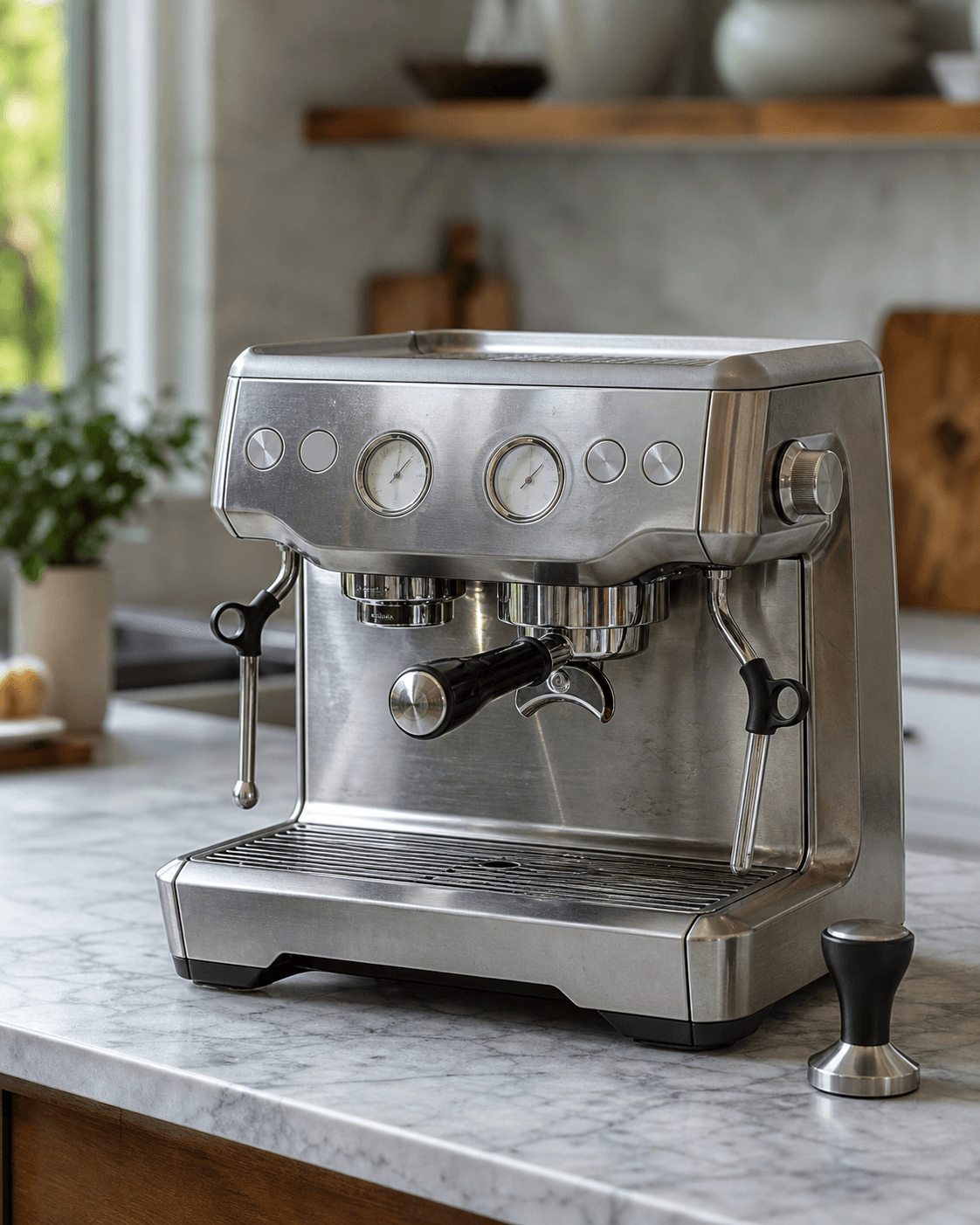
Stainless steel front panel, a genuinely substantial chassis, and internals built around two separate boilers rather than a shared heating element. This is where the extra size and weight go — you're not paying for a bigger footprint for no reason, you're paying for the space two boilers actually require. The build quality shows in details like the PID display, which is more legible and more clearly labeled than the small indicator lights on cheaper Breville machines.
Dual boilers: what it actually buys you
A single-boiler machine, no matter how well it manages temperature, has to choose between brewing and steaming at any given moment — even fast-recovery thermocoil designs like the ones in De'Longhi's lineup are managing one heating element's priorities. The Dual Boiler's brew boiler and steam boiler are physically separate, each with its own PID control loop. Practically, this means you can pull a shot and have someone else steam milk at the same time without either process suffering — genuinely useful if you're making more than one drink, and functionally impossible on a single-boiler machine like the Gaggia Classic Evo Pro or Rancilio Silvia.
PID and temperature stability
The adjustable PID is the other headline feature, and it matters more than the marketing suggests. Rather than accepting a factory-set thermostat range like the Classic Evo Pro, you dial in an exact target temperature and the boiler holds it — useful for anyone chasing a specific extraction profile on a particular roast, since darker roasts often taste better pulled a few degrees cooler than bright single-origin light roasts.
Pressure and adjustable pre-infusion
Breville built in a genuinely adjustable low-pressure pre-infusion stage here, letting you set how long and how gently the puck saturates before full 9-bar pressure kicks in. This is a meaningfully more precise version of the fixed pre-infusion baked into automatic machines like the Philips 3200 LatteGo — you're tuning it per bean rather than accepting one factory-set ramp.
Portafilter and workflow
The 58mm commercial portafilter puts this squarely in the same aftermarket ecosystem as the Gaggia Classic line and the Rancilio Silvia — precision baskets, bottomless portafilters, and commercial accessories all fit without adapters.
Secondary performance: steam and capacity
Steam performance is the best in this entire batch of reviews — the dedicated steam boiler produces strong, dry steam that textures milk quickly and consistently, and it doesn't degrade if you're steaming a second or third pitcher back to back the way single-boiler machines start to lag. The 2.5-liter tank is generous, matching the machine's larger overall footprint.
Daily use and ergonomics
Warm-up takes longer than a compact single-boiler machine simply because there's more thermal mass to bring to temperature — expect several minutes before both boilers are fully stable, though Breville's standby mode helps if you're running it daily rather than powering fully down each time. Once warmed, the workflow is fast and doesn't force you to choose between drinks the way lesser machines do.
Maintenance and longevity
Two boilers mean two things that eventually need descaling rather than one, and slightly more complexity if something needs service. That said, Breville's build quality and the widespread technician familiarity with this specific model (it's been around since 2014 with only minor revisions) means parts and repair knowledge are both easy to find. This is a machine bought to last many years, and it's built accordingly.
Upgrades and accessories
Being a standard 58mm commercial format, the entire aftermarket is available — precision baskets, bottomless portafilters, upgraded tampers, WDT tools for distribution. Pair it with a serious grinder; a Baratza-tier or better grinder is the natural companion, since underdosing this machine's ceiling with a cheap grinder wastes most of what you paid for.
How it compares
Against the Rancilio Silvia, the Silvia is a simpler, single-boiler machine at roughly half the price — a genuinely good machine, but it can't simultaneously brew and steam, and its PID is aftermarket-only rather than built in.
Against the Breville Barista Pro, the Barista Pro includes a built-in grinder and costs a fraction of the price, but trades away the dual-boiler architecture and the fully adjustable PID — a different tier of machine entirely.
Against the Gaggia Classic Evo Pro, this is genuinely a different class — the Evo Pro is an excellent entry point for under $500, while the Dual Boiler is what you buy once you've identified specific limitations in a machine like the Evo Pro and are ready to pay to remove them.
Value analysis
At roughly $1,999 MSRP, sometimes found around $1,699-1,799 on sale, this isn't a value pick in the traditional sense — it's a specialist purchase for someone who has a specific, identified need for simultaneous brew-and-steam and adjustable PID control. Measured against true commercial equipment costing many times more, it's a legitimate bargain. Measured against a home espresso hobbyist's realistic needs, it's often more machine than necessary.
Known issues
The most commonly reported issue across owner communities is occasional pump or valve wear after several years of heavy daily use — not surprising for a machine this complex, but well within normal expectations for equipment at this price and usage level. Descaling both boilers on schedule matters more here than on single-boiler machines, since neglect affects two systems instead of one.
Verdict
Espresso quality and steam performance both score 9 — this is one of the best-performing machines in the category, full stop. Ease of use sits at 6, reflecting genuine complexity that a beginner doesn't need. Value at 7 acknowledges the price is real money for a real specialist tool. If you've identified simultaneous brew-and-steam and adjustable temperature control as your actual bottleneck, this solves it better than almost anything else on the market.
What we like
- True simultaneous brew-and-steam thanks to genuinely separate boilers, not a shared thermocoil pretending
- PID temperature control with user-adjustable setpoint, not just a fixed factory number
- Commercial 58mm portafilter with adjustable pre-infusion pressure, rare at any price below true commercial gear
What we don't
- Price and footprint both put it well outside "casual buyer" territory
- Still no built-in grinder, so the real cost includes a serious grinder to match its ceiling
Specifications
| Type | Semi-automatic |
|---|---|
| Boiler type | Dual stainless steel boilers — separate dedicated brew and steam boilers |
| PID control | Yes |
| Pressure | 9-bar commercial pump |
| Pre-infusion | Yes |
| Built-in grinder | No |
| Portafilter | 58 mm commercial |
| Water tank | 84 oz (2.5 L) |
| Dimensions | approx. 15.3 in W x 14.8 in D x 15.7 in H |
| Warranty | 2-year limited |
Frequently asked questions
Can it actually brew a shot and steam milk at the same time?
Yes — that's the entire point of a true dual boiler. The brew boiler and steam boiler operate independently, so pulling a shot doesn't rob the steam side of temperature the way single-boiler machines do.
Is the PID setpoint actually adjustable, or just displayed?
Fully adjustable — you can dial in your own brew temperature rather than accept a fixed factory number, which matters if you're chasing a specific roast profile.
Does it come with a grinder?
No. Breville sells this as a machine-only purchase — pair it with a serious grinder like a Fellow Ode Gen 2 or a DF64 to actually use the ceiling this machine offers.
Is this overkill for a home espresso drinker who just wants one shot in the morning?
Honestly, for a single daily shot, yes — a lot of this machine's value shows up when you're pulling several shots and steaming multiple drinks back to back, which most single-person households don't do every day.
How does the adjustable pre-infusion actually work?
You set a low-pressure soak stage before full pump pressure kicks in, which you can tune per bean — a much more precise version of the fixed pre-infusion De'Longhi's automatic machines apply.
Keep reading
- Flair Neo Flex Review: Lever Espresso Without the Boiler, the Price Tag, or the Steam Wand
Fair
Our score: 69 / 100
- Lelit Anna PL41TEM Review: PID Included, No Asterisk
Good
Our score: 71 / 100
- Gaggia Classic Evo Pro Review: The Refresh Nobody Asked For, Except Everyone Did
Good
Our score: 72 / 100
- De'Longhi Magnifica Evo Review: I Tried to Break the Cheap Super-Auto
Fair
Our score: 69 / 100