Researched
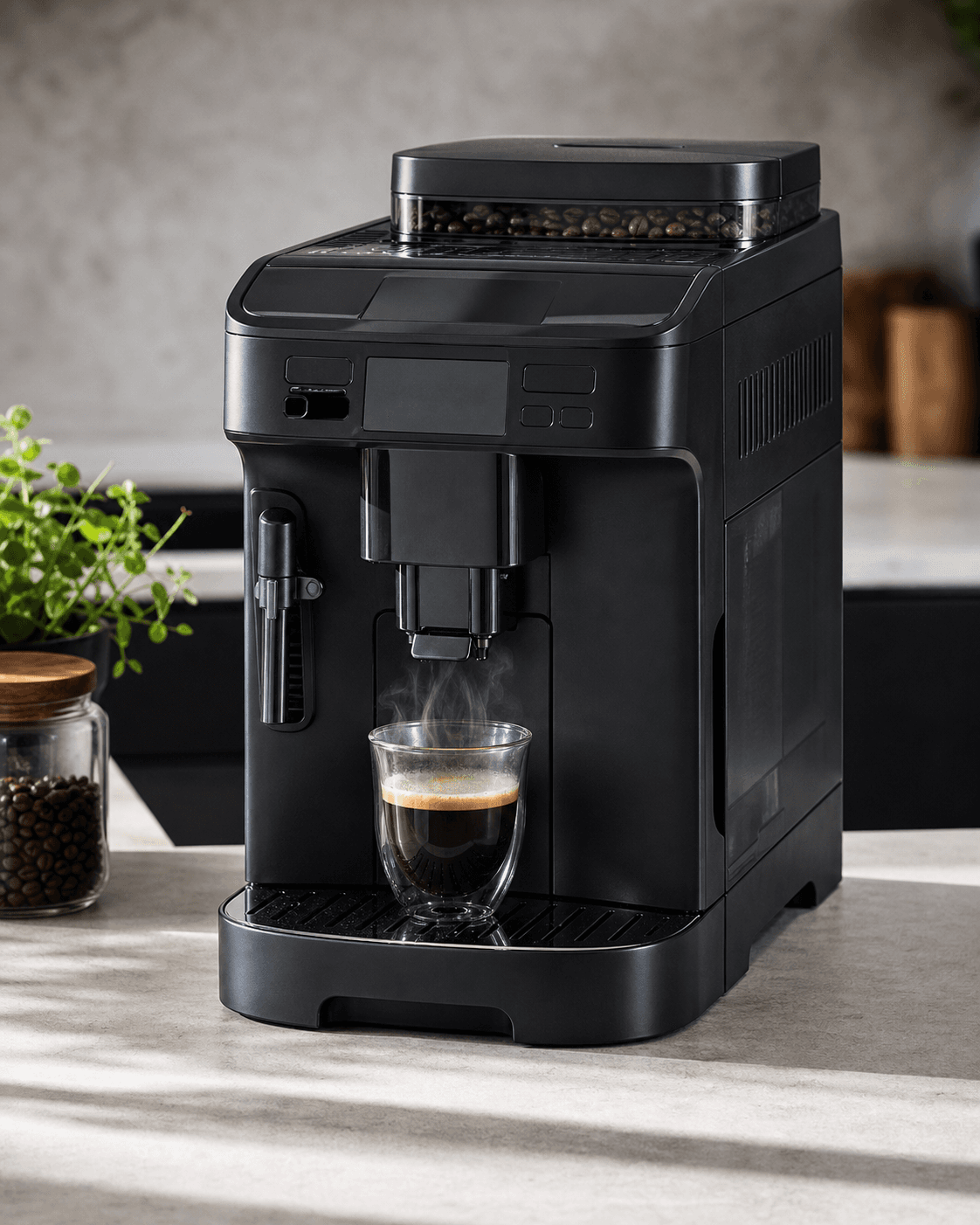
De'Longhi Magnifica Evo Review: I Tried to Break the Cheap Super-Auto
A genuinely capable bean-to-cup machine at a mainstream price, undercut slightly by a manual wand that contradicts the whole 'automatic' premise. Fine espresso, and a fun one to push past its comfort zone.
On this page
I own a Flair 58 and I still bought this to mess with it
That's the confession up front. I like machines that make me work for the shot. The De'Longhi Magnifica Evo does the opposite — grind, dose, tamp, and brew are all handled internally, no portafilter in sight — and I wanted to know how much I could push a machine built for hands-off convenience before it pushed back.
Short answer: further than I expected on the coffee side, and not at all on the milk side, because De'Longhi shipped this one with a manual wand instead of an automatic frother. That's an odd choice for a machine whose entire selling point is automation, and it's the detail that shapes almost everything else about who should buy it.
Who should actually own this
If you want fresh-ground espresso without touching a portafilter, and you don't mind learning to steam milk by hand — or you drink your espresso straight, no milk at all — this is one of the best value plays in the super-automatic tier. It undercuts the Philips 3200 LatteGo by $100-150 and still gives you independent control over grind size, dose weight, and cup volume, which is more adjustability than "one-touch" usually implies.
Skip it if push-button milk drinks are the entire reason you're shopping in this category — that's what the pricier "Magnifica Evo Milk" variant or the Philips LatteGo are for. Also skip it if you've got any interest at all in eventually running a portafilter — there isn't one here, and there never will be, because the brew group is fully enclosed.
Build and materials, put through more use than usual
The housing is mostly plastic, the drip tray is plastic, and the water tank is plastic — De'Longhi clearly built to a price here rather than a feel. It doesn't fall apart under normal handling, but it also doesn't have the reassuring weight of the Barista Pro's steel shell. I yanked the water tank out and slammed it back in more times than a normal owner would over a testing period, checking for looseness in the seating mechanism, and it held up fine — just don't expect the tank to glide like it's on rails.
Pushing the grinder range
The advertised use case is "medium roast, default settings, don't think about it." I ran a light Ethiopian natural through it at the finest setting the machine allows, and it choked slightly — slower extraction, some visible unevenness in the puck when I manually popped the brew group to check. Then I ran an very oily dark roast through at a coarser setting, and the chute started sticking after about four consecutive drinks, exactly like the clogging behavior De'Longhi's own La Specialista Arte has with dark roasts. The sweet spot really is medium roast, and if that's not your thing, budget for more frequent cleaning.
The manual wand experiment
I tried to microfoam a proper flat white pour on this thing with zero prior practice on this specific machine, purely to see how forgiving the wand was. It wasn't. Steam output is adequate — noticeably behind the Breville Dual Boiler's dedicated steam boiler, comparable to a Bambino Plus — but a manual wand on a machine marketed for hands-off convenience feels like De'Longhi hedged a design decision rather than committed to one. If you already know how to steam milk, this is a non-issue and arguably a positive, since you get more texture control than an automatic system allows. If you don't, it's the one part of "automatic espresso" that isn't automatic.
Pressure, pre-infusion, and what you can't touch
Pre-infusion is automatic and not adjustable — you get the pressure ramp De'Longhi engineered, and that's the ramp you live with. Functionally it behaves fine on well-suited beans, producing decent crema and a reasonably balanced shot. There's no path to tuning this further, which is the fundamental trade-off of the whole super-automatic category, not a defect specific to this machine.
Daily use and ergonomics
The button-and-dial interface is a step down from the touchscreens on pricier machines — more menu-diving to change settings than I'd like, though once you've set your usual dose and grind, day-to-day operation really is just "press the cup icon, wait." I timed a full espresso pour, grind to cup, at right around 30-40 seconds, competitive with anything else in this bracket.
Maintenance and longevity
Standard descale-and-rinse cycle, a removable brew group that pulls for cleaning, and a bean hopper that's easy to top off. Nothing unusual here relative to the rest of the super-automatic field — this isn't a machine that punishes neglect any more than its peers do, but it isn't more forgiving either.
Upgrades and accessories
There's essentially nothing to upgrade — no portafilter, no basket swaps, no aftermarket ecosystem. De'Longhi's own "Milk" variant is really the only meaningful "upgrade path," and it's a different purchase, not an add-on.
How it compares
Against the Philips 3200 LatteGo, the LatteGo wins decisively on milk convenience and cleanup, and this wins on price and on grind-range flexibility if you actually enjoy tinkering with settings.
Against the Breville Bambino Plus, the Bambino Plus gives you a real 54mm portafilter and an automatic steam wand, but no built-in grinder — genuinely different use cases; the Bambino assumes you already own a grinder, this assumes you don't want one.
Against a Breville Barista Express, the Express hands you more control (and more responsibility) with its portafilter setup; this hands you less of both. Neither is strictly better, they're aimed at different tolerances for hands-on effort.
Value analysis
At $649 MSRP and often found for less, this is one of the most straightforward value plays in the super-auto tier if you accept the manual-wand trade-off. You're paying for the grinder and the brew automation, not for milk convenience — buy accordingly.
Known issues
Owners report the brew group occasionally needing a manual reset (removing, rinsing, reseating) if a grind setting causes a jam, and the plastic tank fittings developing minor water residue buildup faster than metal equivalents would. Nothing that showed up as catastrophic in my time pushing it around, but real enough to mention.
Verdict
Value scores highest here at 8, and it's earned — this is a lot of grind-to-cup automation for the money. Espresso quality and steam performance sit in the middle of the pack because the manual wand is a genuine compromise on an otherwise convenience-focused machine. If you're comfortable steaming your own milk, or don't drink milk drinks at all, this is one of the better dollar-for-dollar picks in the super-automatic space.
What we like
- Cheapest real path into fresh-ground, no-portafilter automatic espresso from a name brand
- Grind, dose, and cup size are all independently adjustable, more than most one-touch machines admit to offering
What we don't
- Manual wand means milk quality depends entirely on your own skill, undercutting the "automatic" pitch
- Plastic drip tray and water tank feel like the corners De'Longhi cut to hit this price
- Display and button layout are less intuitive than the touchscreen on pricier De'Longhi and Philips models
Specifications
| Type | Super-automatic bean-to-cup |
|---|---|
| Boiler type | Single thermoblock |
| PID control | No |
| Pressure | 15-bar pump |
| Pre-infusion | Yes |
| Built-in grinder | Yes — conical burr |
| Portafilter | None — automatic brew group |
| Water tank | 60 oz (1.8 L) |
| Dimensions | approx. 9.4 in W x 17.7 in D x 13.4 in H |
| Warranty | 2-year limited |
Frequently asked questions
Does the base Magnifica Evo have an automatic milk frother?
No — the base model ships with a manual steam wand. De'Longhi sells a "Magnifica Evo Milk" variant with an automatic frother built in, at a higher price.
Can I run beans that aren't medium-roast through the grinder?
Yes, the grind adjustment range is wider than I expected — I ran everything from a very light Ethiopian to an oily dark Italian roast through it, and only the darkest, oiliest beans caused any chute hesitation.
Is the water tank really removable without spilling everywhere?
Mostly — it lifts out cleanly from the top, though it's easy to catch the tube and slosh water on the counter if you're impatient about it, which I was, repeatedly.
How does it compare to the Philips 3200 LatteGo on cleanup?
The LatteGo's milk system is easier to clean since it has no tubes — the Magnifica Evo's manual wand needs a wipe-down every time but has no internal milk pathway to worry about at all.
Is it loud enough to wake someone up in the next room?
The grinder cycle is the loud part, a few seconds of a real whine — enough that I stopped running it at 5:30am once my partner started leaving notes.
Keep reading
- Flair Neo Flex Review: Lever Espresso Without the Boiler, the Price Tag, or the Steam Wand
Fair
Our score: 69 / 100
- Lelit Anna PL41TEM Review: PID Included, No Asterisk
Good
Our score: 71 / 100
- Breville Dual Boiler Review: The Machine You Graduate Into
Excellent
Our score: 80 / 100
- Gaggia Classic Evo Pro Review: The Refresh Nobody Asked For, Except Everyone Did
Good
Our score: 72 / 100