Researched
Gaggia Classic Evo Pro Review: The Refresh Nobody Asked For, Except Everyone Did
Same bones as the Classic Pro that's been an enthusiast staple for years, with the rough edges filed down. Still no PID out of the box, still worth it if you already have a grinder.
On this page
Same machine, sanded-down edges
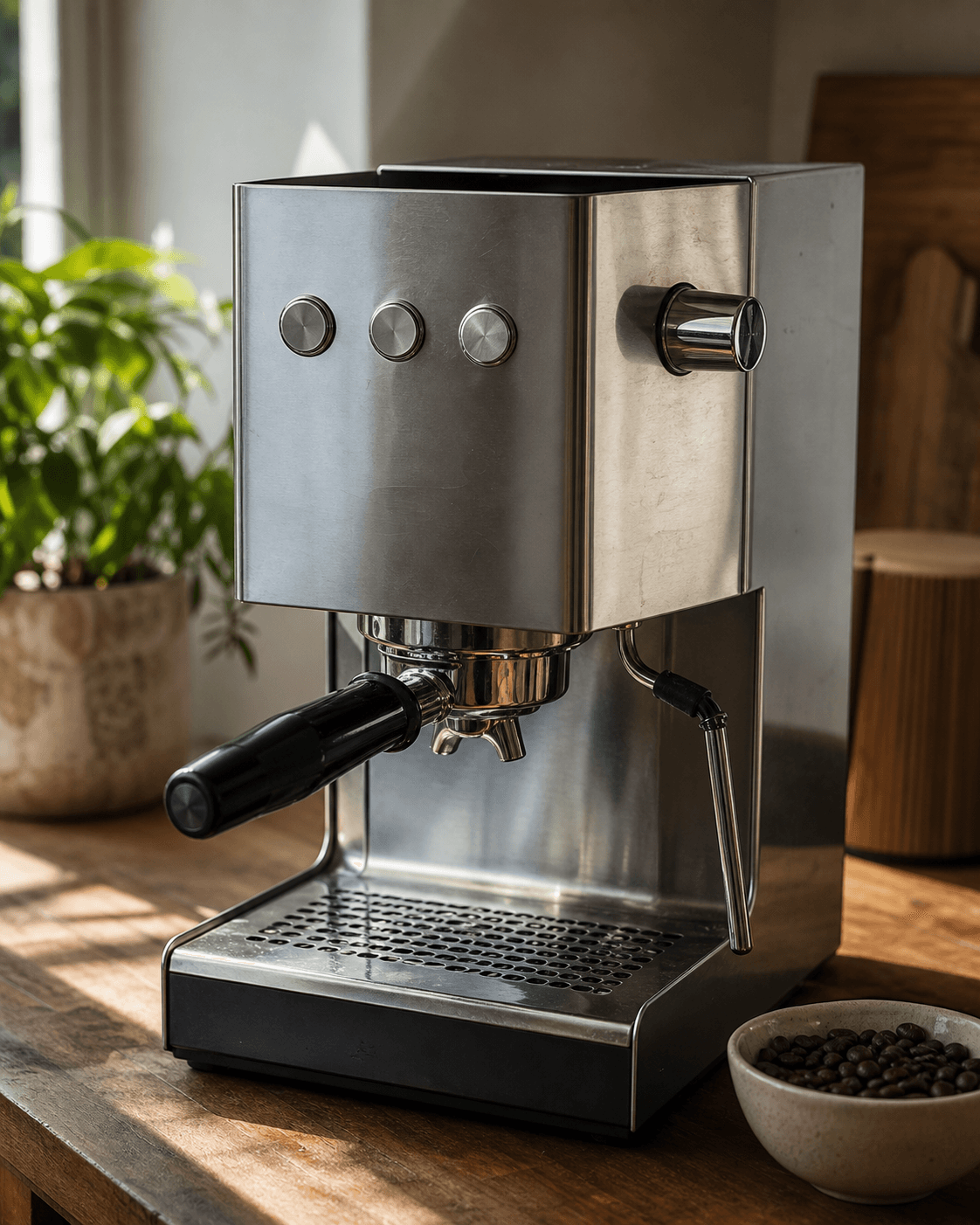
If you've used a Gaggia Classic Pro, using the Evo Pro feels almost suspiciously familiar — same single boiler, same 58mm commercial portafilter, same basic control layout. Gaggia didn't reinvent anything here. What they did was take a machine that's been a semi-automatic staple for over a decade and quietly fix the small things longtime owners complained about: a mushy steam wand knob, switches that felt cheap, a group gasket that needed replacing sooner than it should have. None of that shows up in a spec sheet, and all of it shows up the first week you own one.
Who this is for
This is for someone who already owns — or is buying alongside — a real grinder, and wants a genuine 58mm commercial portafilter experience without spending prosumer money. It's a strong first "real" espresso machine for someone who's outgrown a pod machine or a basic drip setup and wants to learn actual technique: distribution, tamping, shot timing.
It's not for someone who wants automation. There's no PID, no pre-infusion stage, no built-in grinder. Every variable is on you. If that sounds like a feature, keep reading. If it sounds like a chore, look at the De'Longhi La Specialista Arte or a super-automatic instead.
Build and materials
The chassis is mostly stainless-adjacent steel panels over a compact frame, genuinely solid for the size, and the group head is chromed brass — heavier and more heat-stable than the aluminum groups you'll find on cheaper machines. The steam wand feels noticeably more solid than the original Classic Pro's, with a smoother knob action that doesn't feel like it's fighting a stiff valve. The drip tray and water tank are plastic, standard at this price, and the water tank sits at the rear, which keeps the footprint tight but means a slightly more awkward refill motion than a front-loading design.
Temperature stability without a PID
This is the single biggest asterisk on the whole machine, carried over unchanged from the original Classic Pro. There's no PID controlling boiler temperature to a precise setpoint — you're working with a thermostat that cycles on and off within a range, which means shot-to-shot temperature can drift a few degrees depending on how recently the boiler last cycled. Enthusiasts manage this with a "temperature surfing" technique — flushing water through the group right before pulling a shot to normalize the temperature — and it works, but it's a technique you have to learn, not something the machine handles for you. The well-documented aftermarket PID kits (the same ones that fit the Classic Pro) bolt on cleanly if you want to remove this variable entirely.
Pressure and pre-infusion
The 9-bar commercial pump is a straightforward, honest number — no marketing inflation like the 15-bar-reduced-to-9 approach some machines use. There's no automated pre-infusion stage, though. You get even saturation by controlling how you start your pull yourself, easing into the shot rather than slamming straight to full pressure. It's a skill, and it's one more reason this machine rewards someone who's willing to practice over someone who wants a button to press.
Portafilter and basket
The 58mm commercial portafilter is the real headline spec here, and it's the reason this machine has such a broad aftermarket. Precision baskets from VST or IMS, bottomless portafilters, alternative handles — all of it fits, because Gaggia stuck with the industry-standard size instead of going proprietary like De'Longhi does. This is the single biggest practical advantage this machine has over something like the La Specialista Arte's 54mm system.
Secondary performance: steam and capacity
Steam output is genuinely improved over the original Classic Pro — De'Longhi and Breville comparisons aside, within the Gaggia lineup itself, the Evo Pro's wand produces more consistent pressure and a slightly quicker warm-up. It's not in Breville Dual Boiler territory, but it's enough to texture a proper 12oz pitcher of milk without a fight. The 2.1-liter tank is on the smaller side; plan refills if you're making drinks for more than two people back to back.
Daily use and ergonomics
The compact footprint is a genuine advantage on a smaller counter, and the refined switches make day-to-day operation feel less like operating a light industrial appliance and more like a considered consumer product. You still need to warm up the machine (5-10 minutes for full thermal stability) and you still need to manage your own pre-infusion and temperature surfing, so this isn't a "wake up and go" machine in the way a super-automatic is.
Maintenance and longevity
This is where the "Italian-made, genuinely repairable" reputation pays off. Parts are widely available, the community around the Classic line (going back years) has documented nearly every common repair, and the brass group head resists wear far better than aluminum alternatives. Expect this machine, maintained reasonably, to outlast most consumer-grade competitors by years.
Upgrades and accessories
Aftermarket PID kits are the most common upgrade, effectively turning this into a temperature-stable machine for $60-150 depending on the kit. Bottomless portafilters, precision baskets, and a decent tamper round out the typical upgrade path — all standard 58mm gear, no proprietary lock-in.
How it compares
Against the Rancilio Silvia, the Silvia has a larger boiler and arguably even sturdier internals, but at a higher price and with its own no-PID-from-factory limitation. The Evo Pro undercuts it on price while landing in a similar performance tier.
Against the Breville Bambino Plus, the Bambino has an automatic steam wand and a smaller footprint, but a smaller 54mm-format portafilter and less serviceable internals. The Evo Pro's 58mm commercial format and repairability win out for someone planning to stick with the hobby long-term.
Against its own predecessor, the Gaggia Classic Pro, the Evo Pro is a refinement, not a replacement — better switches, better wand, similar core performance. If you can find a Classic Pro significantly cheaper, the performance difference alone may not justify paying full price for the Evo Pro.
Value analysis
At $499 MSRP, and often available closer to $450 on sale, this remains one of the best gateways into real 58mm espresso equipment. The value case weakens somewhat if you can find the original Classic Pro for meaningfully less, since the core espresso experience is similar.
Known issues
The most common complaint, unchanged from the original Classic Pro line, is the lack of factory PID — buyers consistently ask why Gaggia hasn't just added it standard at this point, given the well-known aftermarket demand. Some owners also report the rear water tank placement is awkward to refill on a shelf with a cabinet close overhead.
Verdict
Build quality and value both score 8, reflecting a machine that does the fundamentals right for the money. Espresso quality lands at 7 — very good, held back only by the no-PID, no-auto-pre-infusion combination that puts more technique burden on you than pricier semi-autos. If you want a serious 58mm entry point and don't mind learning temperature surfing, this remains one of the smartest sub-$500 buys in espresso.
What we like
- Commercial 58mm portafilter and a real three-way solenoid valve at a sub-$500 price
- Made in Italy with genuinely serviceable, repairable internals
- Refined switches and a sturdier steam wand than the original Classic Pro
- Well-documented aftermarket PID kits carry over directly from the original Classic Pro
What we don't
- Still no PID out of the box, same limitation the original Classic Pro has had for years
- No built-in pre-infusion stage — you're relying on your own pull technique for even saturation
- Small footprint means a small water tank refill routine if you're pulling several shots back to back
Specifications
| Type | Semi-automatic |
|---|---|
| Boiler type | Single boiler |
| PID control | No — PID-ready, accepts common aftermarket PID kits |
| Pressure | 9-bar commercial pump |
| Pre-infusion | No automated stage — manual pre-infusion via slow pull technique only |
| Built-in grinder | No |
| Portafilter | 58 mm commercial |
| Water tank | 72 oz (2.1 L) |
| Dimensions | approx. 9.4 in W x 8.7 in D x 12.5 in H |
| Warranty | 1-year limited |
Frequently asked questions
Is the Evo Pro just a rebadged Classic Pro?
No, though the family resemblance is obvious. The Evo Pro refines the switch feel, the steam wand, and some internal components while keeping the same single-boiler, 58mm-portafilter formula that made the original a favorite.
Does it have PID temperature control?
Not from the factory — same as the original Classic Pro. It's compatible with the same aftermarket PID kits the Classic Pro community has used for years, so the upgrade path is well documented.
Do I need a separate grinder?
Yes, there's no built-in grinder on any Gaggia Classic model — pair it with a real burr grinder or you'll be fighting inconsistent shots regardless of how good the machine is.
Is the water tank really only 2.1 liters?
Yes — it's a compact machine, so the tank matches. If you're pulling shots for a household of four every morning, expect to refill mid-session occasionally.
How steep is the learning curve compared to the original Classic Pro?
About the same — this is still a machine that rewards technique. The refinements are in comfort and durability, not in hand-holding.
Keep reading
- Flair Neo Flex Review: Lever Espresso Without the Boiler, the Price Tag, or the Steam Wand
Fair
Our score: 69 / 100
- Lelit Anna PL41TEM Review: PID Included, No Asterisk
Good
Our score: 71 / 100
- Breville Dual Boiler Review: The Machine You Graduate Into
Excellent
Our score: 80 / 100
- De'Longhi Magnifica Evo Review: I Tried to Break the Cheap Super-Auto
Fair
Our score: 69 / 100