Researched
Lelit Anna PL41TEM Review: PID Included, No Asterisk
The rare budget-adjacent machine that ships with a real PID instead of making you buy one separately. Simple, honest, and a genuine alternative to the Gaggia Classic line for anyone who wants factory temperature control.
On this page
The PID is the whole pitch, and it's not a gimmick
Most machines in this price range make you choose: either accept a bare thermostat and add a PID kit yourself, or pay significantly more for a machine that includes one from the factory. The Lelit Anna PL41TEM skips that choice entirely — it ships with a working digital PID display, set at the factory and adjustable by the owner, for a price that sits right next to machines that don't have one at all.
That's a genuinely useful thing to know before you start comparing spec sheets, because "PID included" quietly changes the value math on this whole category.
Who this is for
This is for someone shopping in the same tier as a Gaggia Classic Pro or Evo Pro who specifically doesn't want to deal with an aftermarket PID kit — either because they don't want the DIY install, or because they've priced out kits and realized the Lelit's built-in solution comes out even or cheaper. It assumes, like every machine at this tier, that you already have or are buying a separate grinder.
It's not for someone chasing the biggest brand-name aftermarket ecosystem — Lelit's community is smaller than Gaggia's or Rancilio's, so replacement parts and forum troubleshooting threads are somewhat less abundant, even though the machine itself is well engineered.
Build and materials
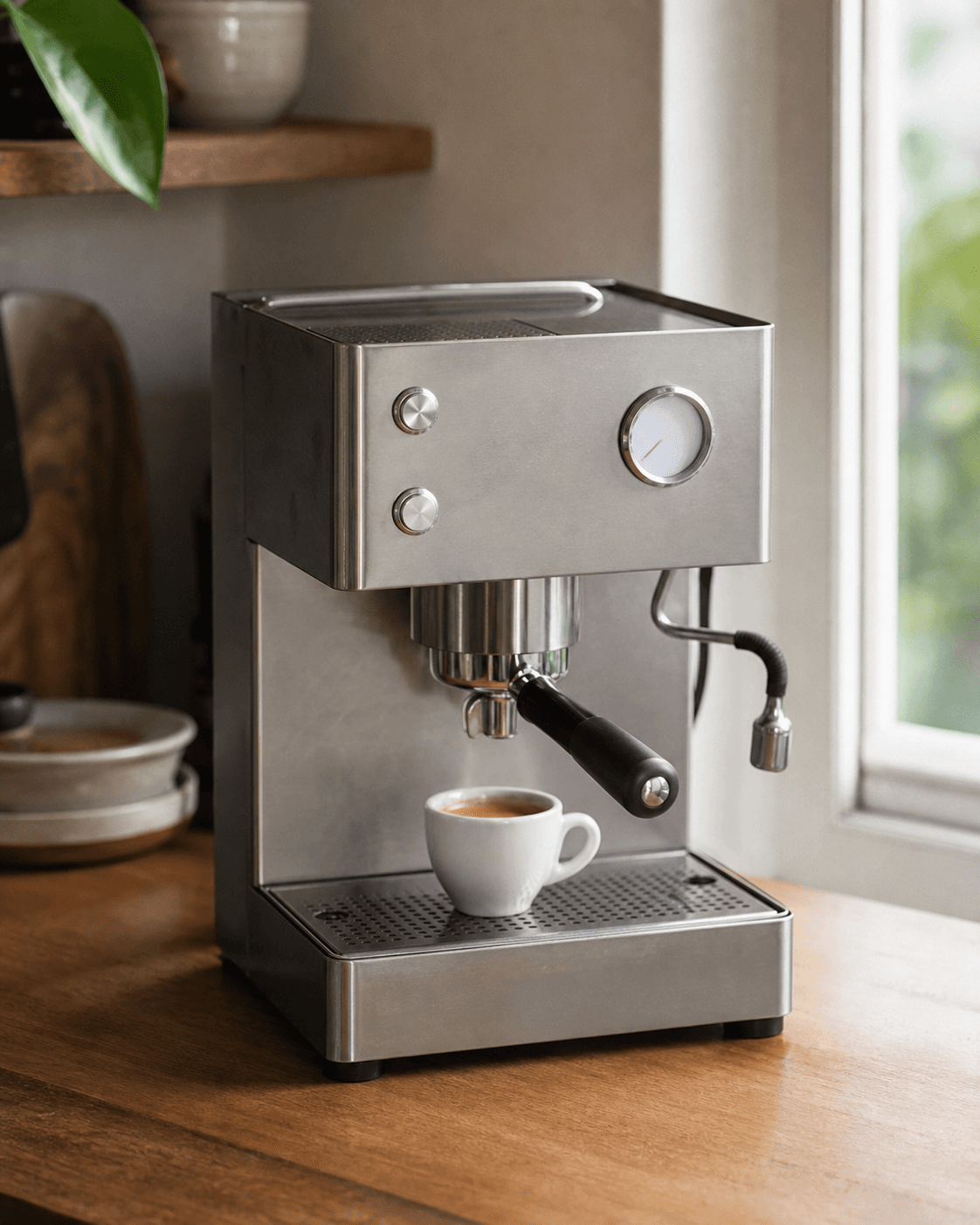
Stainless steel boiler, a compact all-metal-adjacent chassis, and a straightforward internal layout that Italian machines in this tier are generally known for. It doesn't have the switch-and-knob polish of the Gaggia Classic Evo Pro's recent refinements — the pressure gauge is basic analog, the switches feel more utilitarian than tactile — but the core mechanicals are solid and, importantly, designed to be serviced rather than replaced when something wears out.
PID temperature control in practice
The digital PID display shows and holds a set brew temperature, removing the "temperature surfing" technique that Gaggia Classic owners have to learn. You set your target once, and the boiler's heating cycles are managed to hold that number far more tightly than a bare thermostat range would. For anyone dialing in a specific roast — say, wanting to brew a couple degrees cooler for a light filter-style espresso roast — this is a meaningful, practical advantage over any machine in this batch that doesn't have factory PID.
Pressure and the missing pre-infusion stage
The 15-bar pump reduces to roughly 9 bar at the puck through a standard OPV, in line with the rest of the category. There's no automated pre-infusion, which puts the burden of even puck saturation back on your pull technique — the same limitation the Gaggia Classic Evo Pro carries. If pre-infusion matters more to you than PID, this isn't the machine that solves it.
Portafilter and basket fit
The 57mm portafilter is close enough to the 58mm commercial standard that a lot of aftermarket gear fits, but "close enough" is doing some work in that sentence — some precision baskets and bottomless portafilters designed strictly for 58mm need checking before you buy, since tolerances vary by manufacturer. This is a real, if minor, practical friction point compared to a true 58mm machine like the Rancilio Silvia.
Secondary performance: steam and capacity
Steam output is adequate for single-drink milk texturing — comparable to the Gaggia Classic Evo Pro, behind the dedicated steam boiler on something like the Breville Dual Boiler. The roughly 1.8-liter tank is on the smaller side, in line with the compact chassis.
Daily use and ergonomics
Because it has a real PID, day-to-day use is simpler than a no-PID competitor in one specific way: you don't need to learn temperature surfing. Everything else — grinding, dosing, tamping, timing your pull — is the same manual workflow every semi-automatic in this tier demands.
Maintenance and longevity
Stainless steel boilers resist the internal scaling and corrosion issues that plague cheaper aluminum boilers over time, and Lelit's straightforward internal design makes basic maintenance approachable for an owner willing to do it themselves. The smaller aftermarket community means sourcing specific replacement parts can take slightly longer than it would for a Gaggia or Rancilio, worth factoring in if you're the type who wants same-week parts availability.
Upgrades and accessories
Standard bottomless portafilters and baskets fit with the caveat noted above about 57mm-versus-58mm tolerances. Beyond that, there isn't much to upgrade — the PID being included from the factory removes the single most common upgrade path other machines in this tier rely on.
How it compares
Against the Gaggia Classic Pro, the Lelit's factory PID is the clear differentiator — the Classic Pro needs an aftermarket kit to get the same temperature stability, though the Classic Pro has a larger community and ecosystem behind it.
Against the Gaggia Classic Evo Pro, this is genuinely a close call. The Evo Pro has better switch feel and a larger installed base; the Lelit has the PID built in rather than requiring you to seek out a kit. If you're going to add a PID kit to the Evo Pro anyway, the Lelit likely comes out even or ahead on total cost.
Against the Rancilio Silvia, the Silvia's larger commercial-grade components and bigger boiler give it an edge in raw steam power and thermal mass, at a meaningfully higher price and without factory PID either.
Value analysis
At $579 MSRP, sometimes found for a bit less, the value case rests entirely on how much you'd otherwise spend on an aftermarket PID kit for a competing machine. Once you account for that, this is one of the more honestly priced machines in the sub-$600 tier.
Known issues
The most common owner complaint is the smaller, less mainstream parts and support ecosystem compared to Gaggia or Rancilio — not a flaw in the machine itself, but a real practical consideration if something breaks and you want fast access to replacement parts. Some owners also note the 57mm basket size requires more care when shopping for upgraded baskets than a true 58mm machine would.
Verdict
Value and build quality both land at 8 — a fair, honest machine that includes a feature (PID) competitors often charge extra for or make you install yourself. Espresso quality at 7 reflects solid, dependable performance held back only by the missing pre-infusion stage. If factory PID matters to you more than brand recognition or aftermarket size, this deserves a serious look next to the Gaggia Classic line.
What we like
- Factory PID at a price where most competitors make you buy an aftermarket kit
- Italian-made stainless boiler with a straightforward, repairable internal layout
- Genuinely compact without sacrificing a real commercial-style portafilter format
What we don't
- No pre-infusion stage, same manual-technique dependency as the Gaggia Classic line
- 57mm basket size means some 58mm aftermarket gear needs double-checking for fit
- Plain analog pressure gauge and basic switches feel utilitarian next to pricier machines
- Smaller owner community than Gaggia or Rancilio means fewer forum threads and slower parts sourcing
Specifications
| Type | Semi-automatic |
|---|---|
| Boiler type | Single boiler |
| PID control | Yes — digital PID display (the "TEM" designation) |
| Pressure | 15-bar pump |
| Pre-infusion | No |
| Built-in grinder | No |
| Portafilter | 57 mm |
| Water tank | approx. 61 oz (1.8 L) |
| Dimensions | approx. 8.7 in W x 11.4 in D x 12.6 in H |
| Warranty | 2-year limited |
Frequently asked questions
What does the "TEM" in PL41TEM mean?
It denotes the version with the digital PID temperature display — Lelit also sells a PL41EM without it, so the TEM suffix is the one to look for if factory temperature control matters to you.
Is the portafilter compatible with standard 58mm baskets?
Mostly — the basket size is 57mm, and many 58mm commercial baskets fit with a snug tolerance, but it's worth checking specific basket brands rather than assuming universal compatibility.
Does it have pre-infusion?
No automated pre-infusion stage — you're relying on your own slow-start pull technique, the same limitation the Gaggia Classic Evo Pro has.
How does the build quality compare to the Gaggia Classic line?
Comparable in the ways that matter — Italian-made, stainless boiler, repairable — though the Lelit's switches and gauge feel slightly more basic and utilitarian.
Do I need a separate grinder?
Yes, same as every semi-automatic in this list — there's no built-in grinder, so pair it with a real burr grinder to actually use what the machine offers.
Keep reading
- Flair Neo Flex Review: Lever Espresso Without the Boiler, the Price Tag, or the Steam Wand
Fair
Our score: 69 / 100
- Breville Dual Boiler Review: The Machine You Graduate Into
Excellent
Our score: 80 / 100
- Gaggia Classic Evo Pro Review: The Refresh Nobody Asked For, Except Everyone Did
Good
Our score: 72 / 100
- De'Longhi Magnifica Evo Review: I Tried to Break the Cheap Super-Auto
Fair
Our score: 69 / 100