Researched
De'Longhi La Specialista Arte Review: The Scale Does the Thinking
A genuinely clever all-in-one — the built-in scale-fed grinder removes real beginner mistakes — but the 54mm portafilter and lack of PID mean it's a ceiling as much as a launchpad.
On this page
A grinder that knows when to stop
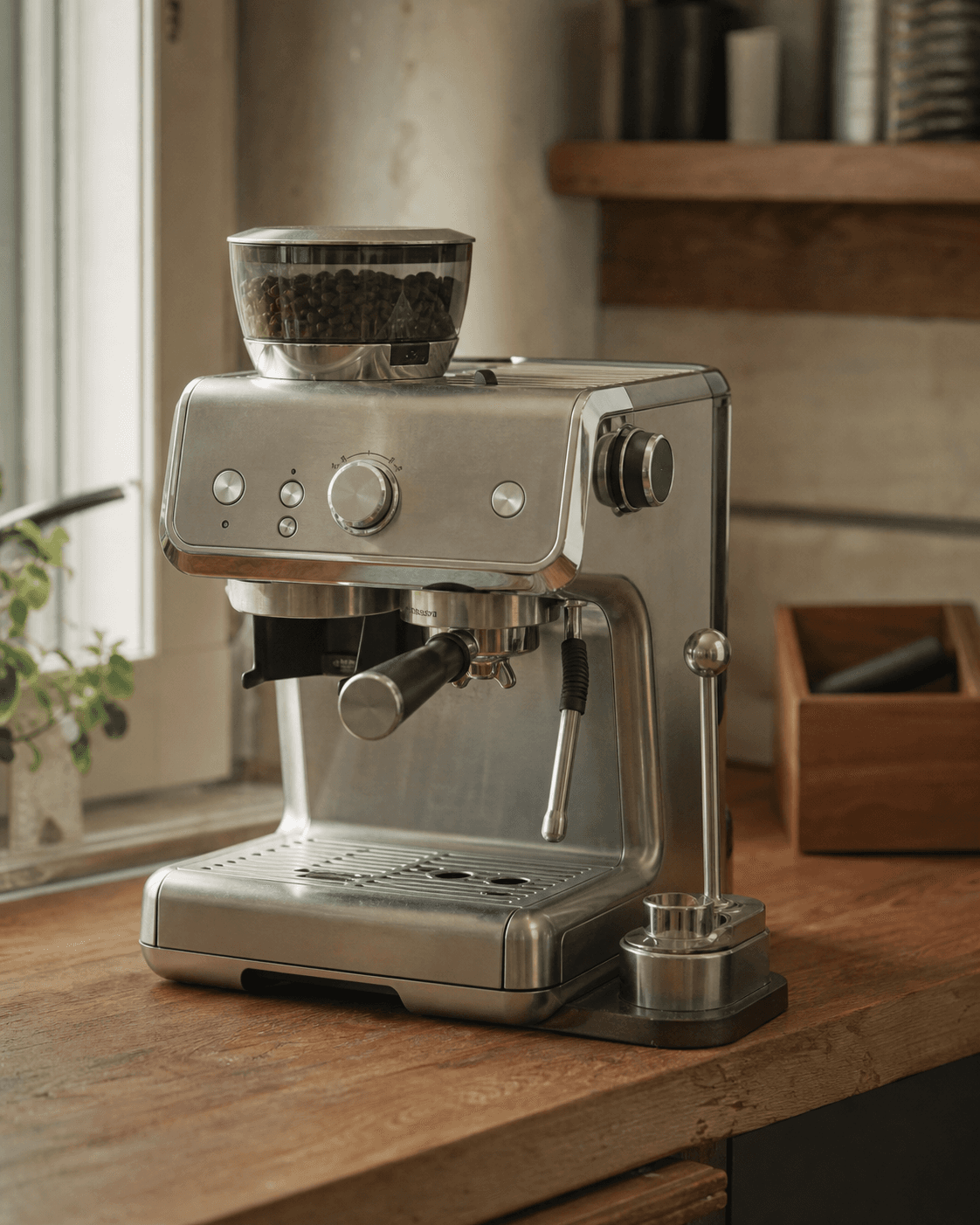
Most built-in grinders on espresso machines are an afterthought — a stepped dial bolted onto the side because the marketing team wanted to say "grinder included." The La Specialista Arte is different in one specific, meaningful way: its hopper sits on a load cell, and it stops grinding when the dose hits your programmed weight, not after a fixed number of seconds. That sounds like a small thing until you've used a timer-based built-in grinder that drifts by two grams between a fresh bag and one that's three weeks old and gone stale. De'Longhi calls this Sensor Grinding Technology, and it's the single best reason to consider this machine over a De'Longhi Magnifica Evo or a Breville Barista Express with the same "grinder built in" pitch.
That doesn't make it a perfect machine. It makes it a very well-targeted one — aimed squarely at someone who wants the fewest possible decisions between waking up and drinking espresso, but who still wants that espresso to be good, not just convenient.
Who this is actually for
Buy this if you've never owned a grinder, don't want to own two machines, and you're the kind of person who will actually use a "shot ratio" setting once it's programmed for you. The whole value proposition collapses if you're not going to lean on the automation — if you'd rather manually weigh your dose with your own scale, you're paying for a feature you won't use.
Skip it if you already own a grinder you like. Buying this to replace a decent grinder-plus-machine setup is a downgrade in most cases, since you're trading your existing burr set for De'Longhi's conical unit and a smaller portafilter. Also skip it if you think you'll want to graduate to 58mm gear, VST baskets, bottomless portafilters, or anything from the wider commercial aftermarket — that whole ecosystem assumes 58mm, and the Arte's 54mm size locks you out of most of it.
Borderline case: if you're currently on a Breville Barista Express and grinding-dosing consistency has been your main complaint, the Arte's weight-based approach is worth the lateral move. If your complaint has been something else — steam power, footprint, build quality — this doesn't fix it.
Build and materials
The chassis is mostly metal on the top and front panels, with a matte black finish that hides fingerprints better than Breville's brushed steel. The water tank and drip tray are plastic, which is standard at this price point and not a knock specifically against De'Longhi. The steam wand is manual, metal, and articulates in more directions than the Barista Express's wand — a small ergonomic win if you're pouring latte art.
Where it feels less premium is the portafilter handle and the grinder hopper lid — both are lighter plastic than you'd want on a $799 machine, and the hopper lid in particular has a reputation for becoming brittle after a year or two of removal for cleaning. It's not a structural failure point, just a place where De'Longhi clearly cut cost to hit the price.
Grinding and dosing
This is the machine's reason for existing, so it's worth walking through in detail. The conical burr grinder offers stepless adjustment, which beats stepped grinders for espresso because you can chase a 25-30 second shot time without being stuck between "too fast" and "too slow" settings. Dial-in still takes the usual trial and error — nothing removes that — but once you land on a setting, the weight-based dosing keeps you there shot after shot, which is the part that traditionally drifts on cheaper built-ins.
The catch: oily dark-roast beans gum up the chute more than lighter roasts. If you're a dark-roast drinker, budget for a chute cleaning brush session every week or two, not "whenever it clogs," because a partially clogged chute doesn't fail loudly — it just quietly under-doses, and the scale thinks it hit target when the chute simply stopped feeding beans.
Pressure and pre-infusion
The 15-bar pump is a marketing number more than a functional one — nearly every prosumer machine reduces that to around 9 bar at the puck via an internal valve, and the Arte does the same. What actually matters here is pre-infusion: Active Pre-infusion wets the puck at low pressure before ramping up, which reduces channeling on medium grinds and is genuinely useful for anyone who hasn't yet learned to tamp with perfectly even distribution. It's not adjustable in the way a Lelit Bianca's is, but it's on, it works, and it's one of the reasons shots taste more consistent than the pressure number alone would suggest.
Milk and steam
The manual wand puts out enough steam to microfoam a 12oz pitcher of milk in 45-60 seconds, competitive with the Barista Express and noticeably better than what you get from most super-automatics like the Philips 3200 LatteGo's automated system in terms of texture control — because you're driving it by hand. That's a double-edged point: better ceiling, but you have to learn to steam. If you want push-button milk, this isn't that machine.
Daily use and ergonomics
The workflow is genuinely fast once you know it: hopper has beans, tap the dose button, grinder runs and stops itself, tamp, lock in, brew. The digital display shows shot timer and temperature status, which is more feedback than the Barista Express gives you. The single-boiler thermocoil design means you're waiting for a temperature-ready light between pulling a shot and steaming milk — not long, usually under 20 seconds, but it's there, and it's the trade-off you accept for not paying for a dual boiler like the Breville Dual Boiler.
Maintenance and longevity
Descaling is standard citric-acid-solution-and-run-cycle, same as any De'Longhi. The grinder burrs are rated for years of home use and aren't user-replaceable in the sense a Baratza's are — when they dull, you're looking at a service call or living with it. The three-way solenoid-style venting on the group head isn't as robust as what you'd get on a Rancilio Silvia's commercial parts, so expect a shorter realistic service life — call it 5-7 years of daily use before something in the grinder or pump needs attention, versus a decade-plus for a Silvia if maintained.
Upgrades and accessories
There isn't much of an aftermarket here, which is the tradeoff for the proprietary 54mm size. De'Longhi sells replacement baskets and a bottomless portafilter in the same size, and that's about the extent of it. If tinkering and upgrading are part of the hobby for you, this machine will frustrate you within a year.
How it compares
Against the Breville Barista Express, the Arte's weight-based dosing is the clear differentiator — the Express uses a timed dose that drifts, full stop. The Express counters with a broader accessory ecosystem and a slightly more refined steam wand.
Against the Breville Barista Pro, you're choosing between the Pro's faster ThermoJet heat-up (about 3 seconds to temperature versus the Arte's thermocoil warm-up) and the Arte's superior dosing consistency. If speed to first shot matters more to your morning than dose accuracy, the Pro wins that trade.
Against the Gaggia Classic Evo Pro, this is really a different category of buyer. The Evo Pro assumes you already have a grinder and want a serious, repairable single-boiler machine with a 58mm commercial portafilter. The Arte assumes you don't want to own a separate grinder at all. Neither is wrong; they're just answering different questions.
Value analysis
At $799 MSRP, and commonly found closer to $700-750 on sale, you're paying roughly what a mid-tier standalone grinder alone would cost, and getting the machine bundled in. That's a genuinely good deal if you were going to buy both anyway. It's a worse deal if you already own a grinder, because you can't easily extract that value back out — you're just buying a machine with an extra unused grinder attached.
Known issues
The most common complaint in owner forums isn't the grinder or the pump — it's the hopper lid cracking with rough handling, and occasional descale-light false triggers in hard-water areas that require a firmware reset sequence to clear. Neither is catastrophic, but both are annoying enough that you should know about them going in.
Verdict
The scoring reflects a machine that does its one clever trick very well — espresso quality and value both land at 7-8 — while being held back on ease-of-use ceiling by the 54mm portafilter limiting future upgrades, and steam performance sitting solidly mid-pack rather than exceptional. If the sentence "I don't want to buy a separate grinder" describes you, this is one of the smartest $700-800 purchases in the category. If it doesn't, spend the money on a Gaggia Classic Evo Pro and a real grinder instead.
What we like
- Weight-based dosing genuinely removes the biggest source of shot-to-shot variance for beginners
- One machine replaces a grinder, a machine, and most of a counter's worth of gear
- Pre-infusion and a real conical burr grinder at this price are rare
What we don't
- 54 mm portafilter caps how much you can push the espresso hobby before you outgrow it
- No PID means temperature surfing is still technically happening, just hidden behind a nicer shell
- Bean hopper and grinder chute clog with oily dark roasts more than De'Longhi admits
- Grinder motor is noticeably louder than a standalone burr grinder for the few seconds it runs
Specifications
| Type | Semi-automatic with integrated conical burr grinder |
|---|---|
| Boiler type | Single thermocoil (Advanced Thermocoil heating system) |
| PID control | No — digital thermostat, not a user-adjustable PID loop |
| Pressure | 15-bar pump |
| Pre-infusion | Yes — Active Pre-infusion mode |
| Built-in grinder | Yes — conical burr with Sensor Grinding Technology (dose by weight) |
| Portafilter | 54 mm |
| Water tank | 61 oz (1.8 L) |
| Dimensions | approx. 8.3 in W x 13.4 in D x 15.7 in H |
| Warranty | 2-year limited |
Frequently asked questions
Does the La Specialista Arte really weigh your dose automatically?
Yes — the hopper sits on a load cell, and the grinder stops dispensing once it hits your programmed gram target. It's accurate to about a tenth of a gram in most reports, which is closer to a standalone scale than you'd expect from a built-in unit.
Is the portafilter compatible with 58mm baskets or bottomless portafilters?
No. It uses De'Longhi's proprietary 54mm size, so the aftermarket ecosystem is much smaller than the 58mm commercial standard — plan on De'Longhi's own accessories.
Does it have a PID?
Not in the marketed sense. It has digital temperature management through the thermocoil system, but De'Longhi doesn't expose a PID readout or let you dial in a setpoint the way a Gaggia Classic Evo Pro with an aftermarket kit would.
Can I use pre-ground coffee?
Yes, there's a bypass doser for pre-ground, though the whole appeal of this machine is the integrated grinder, so most buyers skip it.
How loud is the grinder?
Noticeably louder than a standalone burr grinder like the Fellow Ode — it's a compact motor working through a small chute, so expect a whine in the 75-80 dB range for the few seconds it runs.
Keep reading
- Flair Neo Flex Review: Lever Espresso Without the Boiler, the Price Tag, or the Steam Wand
Fair
Our score: 69 / 100
- Lelit Anna PL41TEM Review: PID Included, No Asterisk
Good
Our score: 71 / 100
- Breville Dual Boiler Review: The Machine You Graduate Into
Excellent
Our score: 80 / 100
- Gaggia Classic Evo Pro Review: The Refresh Nobody Asked For, Except Everyone Did
Good
Our score: 72 / 100