Researched
Flair 58 Review: Espresso With No Plug and No Excuses
The best shot you'll ever pull by hand, and also the only espresso maker where a bad shot is unambiguously your fault. Buy it to learn, not to save counter space.
On this page
There's no cord because there's nothing to plug in
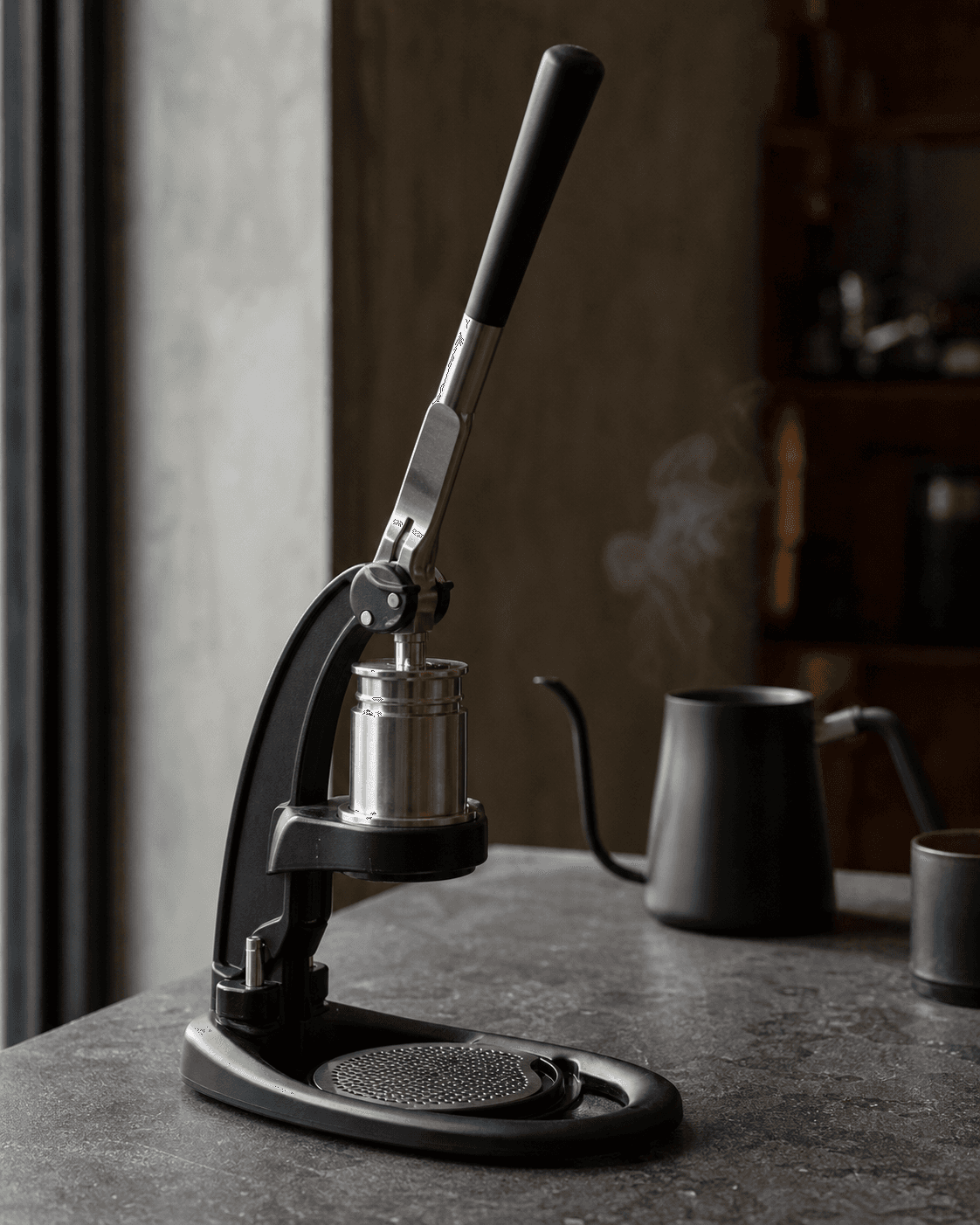
Say that to most people and they assume you mean a battery. You don't. The Flair 58 has no boiler, no pump, no electronics of any kind in its base form. You heat water in your own kettle, pour it into a thermal brew chamber, load a 58mm portafilter you've dosed from your own grinder, and pull a lever. The pressure curve — the actual bar reading on the gauge — comes from your arm and your technique, not a solenoid valve somewhere inside a plastic housing.
That's either the most interesting sentence in this whole category or a complete deal-breaker, and which one it is tells you everything about whether you should buy this machine.
Who should buy this, and who's wasting their money
This is for people who already understand, at least roughly, what a good shot looks like and want to feel the mechanics of pulling one rather than have a machine hide them. If you've pulled shots on a Rancilio Silvia or a Gaggia Classic Pro and found yourself wanting more control over the pressure profile — not just "on" and "off," but the actual ramp — the Flair is the answer. It's also genuinely the right call for anyone tight on space or who travels enough that a full countertop setup doesn't make sense; nothing else in this category packs into a case.
Don't buy this if you want to press a button and get a shot while you do something else. There's no multitasking with a Flair — you stand at it for the full pull, every time. Don't buy it if you don't already own a grinder, because the true cost of a Flair 58 setup is the machine plus a grinder plus a kettle, and that math changes the value picture significantly compared to an all-in-one like the De'Longhi La Specialista Arte. And don't buy it expecting to steam milk — there's no wand, full stop.
Build and materials
This is where the Flair earns most of its reputation. The frame is aluminum, the lever is a solid arm with genuine mechanical leverage behind it, and the whole assembly feels like it was built by people who wanted a lever machine to survive being shipped, unpacked, reassembled, and used daily by someone with no experience. There's essentially nothing to wear out in the way a pump or a solenoid wears out on an electric machine — the failure points are gaskets and o-rings, which are cheap and simple to replace.
How the lever actually works
The Flair uses a spring-assisted lever rather than a pure direct lever like some higher-end machines. You pull down, compressing a spring, and that spring pressure — combined with how you modulate your pull — is what pushes water through the puck. This matters practically: it means you can slow-pull for a longer pre-infusion phase, then apply more force for the main extraction, entirely by feel. A pump machine gives you a fixed pressure curve engineered by De'Longhi or Breville's product team. The Flair gives you the pen and asks you to draw the curve yourself.
Temperature management without a boiler
The brew chamber is designed to hold heat from the water you pour in, but you're still working against a cooling clock — pour too far ahead of your pull and you lose several degrees before extraction starts. Serious Flair owners preheat the whole group with a first pour-and-dump before the real shot, and some add the optional heating element accessory that plugs into an outlet just to keep the chamber warm between shots. It's a real limitation: temperature stability, the thing PID machines exist to solve, is entirely on you here.
Pressure profiling in practice
The pressure gauge (standard on the 58+, optional on the base 58) is what turns "pull the lever" into "pull a specific pressure curve on purpose." Once you've used it for a few weeks, you start recognizing the difference between a fast 30-second ramp to 9 bar and a slow 8-second pre-infusion followed by a firmer push — and you can feel that difference show up in the cup, particularly on lighter roasts that benefit from a gentler ramp.
Secondary performance: capacity, noise, portability
There's no water tank, so capacity per shot is whatever you pour — typically 40-60ml depending on your ratio. Noise is essentially zero; a spring and a lever don't hum. Portability is the standout secondary feature: the Flair 58 was designed to be disassembled and packed, and people genuinely do bring these on trips, something you'd never attempt with a Breville Dual Boiler or even a compact Bambino Plus.
Daily use and ergonomics
The ritual takes longer than pressing a button — figure two to three extra minutes per shot versus an electric machine, once you count boiling water separately. Some people find this meditative. Others find it's one more thing between them and their morning coffee. There's no in-between reaction to this; owners either love the ritual or sell the machine within a few months.
Maintenance and longevity
Because there's so little that can electronically fail, a well-maintained Flair 58 can outlast almost anything else in this list. The main maintenance is periodic gasket replacement (cheap, user-serviceable) and keeping the chamber and portafilter clean. There's no pump to rebuild, no boiler to descale, no solenoid to replace.
Upgrades and accessories
Flair sells a heating element attachment (adds a plug, ironically, but keeps the chamber at temperature between shots), a pressure gauge kit if you started with the base model, and various portafilter basket options. Because it uses a standard 58mm format, some commercial baskets and bottomless portafilters from the wider aftermarket fit as well — more flexibility than the proprietary De'Longhi ecosystem offers.
How it compares
Against the Gaggia Classic Pro, the comparison is really "hands-on lever versus hands-on pump" — the Gaggia still needs electricity and a boiler, and gives you a more repeatable but less expressive shot. The Flair trades repeatability for control.
Against the Rancilio Silvia, both are enthusiast machines that assume a separate grinder and a willingness to learn, but the Silvia at least automates temperature and pressure once you've dialed in your technique on the tamp and grind. The Flair never automates anything.
Against a pump-driven machine like the Breville Barista Express, the Flair simply isn't competing for the same buyer — the Express is an all-in-one for someone who wants less friction, and the Flair is for someone actively seeking more.
Value analysis
At $550-650, the machine itself is a fair price for what is essentially a precision mechanical instrument. The honest value conversation includes the grinder and kettle you'll need alongside it — budget accordingly, and don't compare the sticker price directly against an all-in-one machine that includes a grinder.
Known issues
The most common complaint isn't a defect — it's buyer's remorse from people who underestimated the time commitment per shot. On the mechanical side, some early units had gasket seating issues that caused minor leaks around the brew chamber; a properly seated gasket resolves it, and it's a known, well-documented fix in the community.
Verdict
The scores here look unusual next to the rest of this category on purpose. Espresso quality scores a 9 because a well-pulled Flair shot rivals commercial equipment. Ease of use scores a 4 because there is genuinely no way to make this convenient. Steam performance scores a 1 because there's no steaming at all — that's not a flaw, it's just not what this machine does. If you want the most direct, tactile relationship with your espresso that money can buy, this is it. If you want convenience, look elsewhere in this guide.
What we like
- You feel the entire extraction happen in your hand, which teaches shot mechanics faster than any digital display could
- No electricity, no boiler, nothing to fail electronically — it's almost entirely mechanical
- Genuinely portable — the whole kit disassembles into a case you can travel with
What we don't
- You need a separate kettle and a separate grinder, so the real cost is higher than the machine price suggests
- Every shot is a small physical task — there's no walking away while it brews
- Steaming milk requires a separate device entirely since there's no steam wand
- Temperature management is entirely manual since there's no boiler holding a setpoint
Specifications
| Type | Manual lever (spring-assisted) |
|---|---|
| Boiler type | None — external kettle heats water |
| PID control | No — optional temperature strip/gauge for reference only |
| Pressure | User-controlled via spring-lever |
| Pre-infusion | Manual |
| Built-in grinder | No |
| Portafilter | 58 mm commercial-style |
| Water tank | None — hand-filled brew chamber |
| Dimensions | approx. 6 in W x 10 in D x 15 in H assembled |
| Warranty | 1-year limited |
Frequently asked questions
Do I need a kettle to use the Flair 58?
Yes — you heat water separately (a gooseneck kettle works well) and pour it into the brew chamber just before pulling. There's no onboard heating element.
Can the Flair 58 steam milk?
No. There's no steam wand on any Flair model. Owners typically pair it with a standalone milk frother — the Breville Milk Café or a basic handheld frother covers it.
Is 9 bar of pressure guaranteed on every shot?
Not automatically — pressure comes from how hard and how steadily you pull the lever, so it's closer to "you control the pressure curve" than "the machine hits a fixed number." Most owners use the included gauge to learn a consistent 6-9 bar pull.
How portable is it really?
Genuinely portable. It breaks down into a padded case small enough for carry-on travel, which is unusual for anything that pulls real espresso pressure.
Is there a difference between the Flair 58 and Flair 58+?
The 58+ adds a pressure gauge and a few refinements as standard rather than optional add-ons — otherwise the core lever mechanism is the same.
Keep reading
- Flair Neo Flex Review: Lever Espresso Without the Boiler, the Price Tag, or the Steam Wand
Fair
Our score: 69 / 100
- Lelit Anna PL41TEM Review: PID Included, No Asterisk
Good
Our score: 71 / 100
- Breville Dual Boiler Review: The Machine You Graduate Into
Excellent
Our score: 80 / 100
- Gaggia Classic Evo Pro Review: The Refresh Nobody Asked For, Except Everyone Did
Good
Our score: 72 / 100