Researched
Philips 3200 LatteGo Review: The Milk System Everyone Else Should Copy
The easiest cleanup of any milk system in this category, wrapped around a competent but not exceptional super-automatic. Buy it for the mornings you don't want to think, not for the shots you want to obsess over.
On this page
The part everyone copies eventually
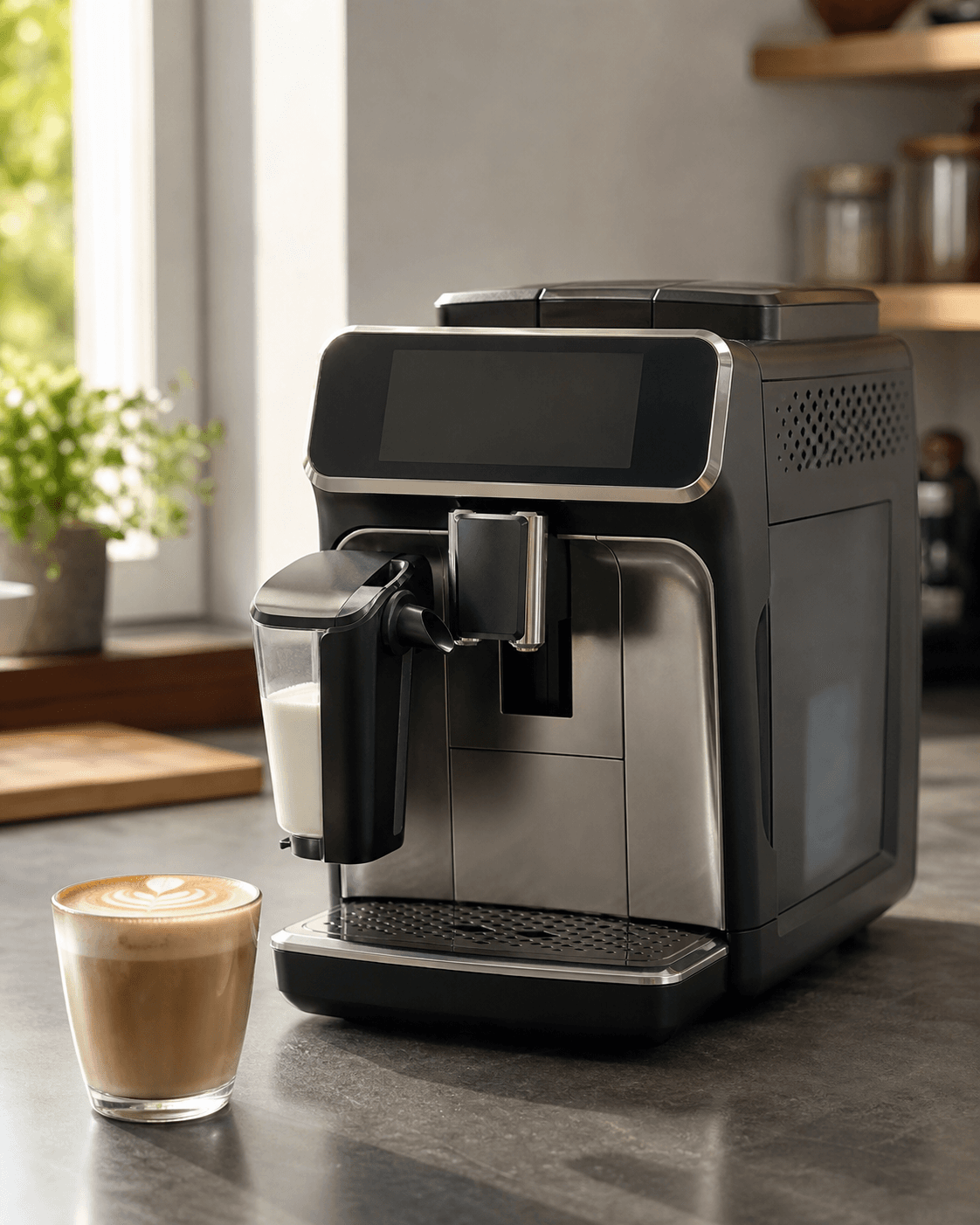
Every super-automatic promises milk drinks with barely any work on your part. Almost none of them make cleaning the milk system that easy too — you end up with a machine that pours a nice cappuccino and then punishes you with a multi-part frother assembly that needs daily disassembly to avoid smelling like old dairy. The Philips 3200 LatteGo solves that specific problem better than anything else in this price range: the milk carafe and whisk are two pieces, no tubing runs through the machine, and you can genuinely rinse the whole assembly under a tap in under a minute. It's such an obvious improvement that you start wondering why every other brand still ships machines with internal milk tubes.
That's the headline. The rest of the machine is a solid, unremarkable super-automatic — which, depending on what you want out of espresso, is either exactly enough or a real limitation.
Who this is for
This is the right machine for someone who wants café-style milk drinks on a schedule — before work, say — with zero cleanup friction and zero interest in learning grind, dose, or tamp. If your current coffee routine involves a pod machine and you want to step up in quality without stepping up in effort, this is a legitimate upgrade.
It's the wrong machine if you've ever described yourself as wanting to "get into" espresso as a hobby. There's no portafilter here, no way to practice distribution technique, no path to buying a bottomless portafilter and watching your pours later. You're locked into whatever the machine's internal brew group decides, forever. It's also not the machine for someone chasing the absolute best shot achievable at home — that ceiling belongs to manual machines like the Flair 58 or well-dialed semi-autos like the Breville Dual Boiler.
Build and materials
The housing is mostly plastic with a metal drip tray and a reasonably solid feel to the control panel. It doesn't feel as premium as the Breville Barista Pro's brushed steel, but it's not flimsy either — Philips has been building these bean-to-cup machines for a long time and the fit and finish reflects that. The LatteGo carafe itself is the standout piece of industrial design in the whole unit: dishwasher-safe, BPA-free plastic, and engineered specifically to avoid the crevices where milk residue usually hides.
Grinding and brewing
The ceramic conical burr grinder offers 12 grind settings, adjustable through the display rather than a dial you feel with your hand. Ceramic burrs run cooler and last longer against the acids in coffee oil than steel, which matters more over a five-year ownership horizon than it does on day one. The brew group pressurizes to a nominal 15 bar, though — as with every machine in this category — what matters is the actual extraction pressure at the puck, which the automatic tamping and dosing target around a fixed, non-adjustable point tuned by Philips.
Milk system in depth
This deserves its own real section because it's the reason to buy this specific machine over a Magnifica Evo or a Barista Express. LatteGo whisks air into cold milk using a spinning mechanism rather than steam injection through a wand, then heats the frothed milk as it's dispensed. The texture is consistent and repeatable — it won't produce the tight microfoam a skilled hand can pull on a manual wand, but it also won't produce the inconsistent foam you get from an untrained hand on that same wand. For most people making a latte on a weekday morning, repeatable-and-good beats occasionally-excellent-if-you-practiced.
Espresso quality ceiling
Be honest with yourself here: a super-automatic's espresso quality is capped by the fact that you can't fix a bad extraction by adjusting your tamp or redistributing grounds — the machine does all of that internally, the same way, every time. When it's dialed in well for a given bean, the shots are genuinely good — balanced, not bitter, reasonable crema. When a bean doesn't suit the machine's fixed parameters, there's less you can do about it than on a semi-automatic.
Daily use and ergonomics
This is where the 3200 LatteGo shines brightest. One-touch buttons for espresso, coffee, cappuccino, and latte macchiato mean the entire interaction is: fill hopper, fill tank, press button, walk away. No dosing scale, no tamping, no steaming technique to maintain. It's the closest thing to a pod machine's convenience while still grinding fresh beans for every cup.
Maintenance and longevity
The internal brew group needs to be pulled out and rinsed under water roughly weekly — Philips makes this reasonably easy with a single-lever release, more accessible than some competitors bury theirs. Descaling follows the usual cycle-and-solution routine. The LatteGo carafe, being dishwasher-safe, removes the single most annoying daily maintenance task that plagues automatic milk systems elsewhere in the category.
Upgrades and accessories
There's not much to upgrade on a super-automatic by design — no portafilter to swap, no baskets to try. Philips sells replacement water filters and occasional accessory carafes, but this isn't a machine you grow with the way you would a semi-automatic.
How it compares
Against the De'Longhi Magnifica Evo, the LatteGo's milk cleanup is the clear win — the Magnifica Evo's base configuration uses a manual steam wand, which means better milk texture potential but real cleaning effort, or a step-up model with a traditional automatic frother that lacks LatteGo's easy-clean design.
Against the Breville Barista Express, this is a convenience-versus-control trade-off. The Express requires you to learn grinding, tamping, and steaming; the LatteGo requires you to learn nothing. The Express's ceiling is meaningfully higher once you've put in the practice.
Against a pod-based machine, the 3200 LatteGo wins clearly on coffee quality since it's grinding fresh beans rather than using a sealed capsule, at a similar level of daily effort.
Value analysis
At $799 MSRP, often available for $650-750, you're paying a premium over base-tier bean-to-cup machines specifically for the LatteGo milk system and the ceramic grinder. If milk-drink cleanup has been your specific frustration with a previous machine, that premium is worth paying. If you rarely drink milk-based espresso drinks, you're paying for a feature you won't use much, and a simpler super-auto or a semi-auto machine would serve you better.
Known issues
The most frequently reported issue is the brew group's plastic components feeling less durable after two-plus years of daily use compared to Philips's own higher-tier LatteGo models. Some owners also note the fixed grind range doesn't accommodate very light, dense roasts as well as beans in the medium range Philips seems to have tuned for.
Verdict
The 8 for ease of use — actually a 9 in the scoring — reflects genuine best-in-class convenience. Espresso quality at 6 is an honest reflection of a machine that's good for what it is but capped by having no portafilter. If painless milk drinks are the priority, this is one of the smartest buys in the super-automatic category. If espresso quality is the priority, spend the same money on a semi-automatic and a decent grinder instead.
What we like
- LatteGo milk system has exactly two parts and no tubes — you can rinse it under a tap in ten seconds
- Ceramic burrs resist wear from acidic light-roast coffee far better than steel
- One-touch drink selection actually works as advertised for espresso, cappuccino, and latte macchiato
- Grind, dose, and cup volume are independently adjustable rather than fixed behind one button
What we don't
- No portafilter means no path into the wider espresso hobby if your taste evolves
- Espresso quality is genuinely good for a super-auto but caps out below anything with a real portafilter
Specifications
| Type | Super-automatic bean-to-cup |
|---|---|
| Boiler type | Single thermoblock |
| PID control | No — fixed digital temperature presets, not user-adjustable |
| Pressure | 15-bar pump |
| Pre-infusion | Yes |
| Built-in grinder | Yes — ceramic burr |
| Portafilter | None — fully automatic brew group |
| Water tank | 60.9 oz (1.8 L) |
| Dimensions | approx. 9.4 in W x 17.3 in D x 14.9 in H |
| Warranty | 2-year limited |
Frequently asked questions
What makes LatteGo different from a traditional automatic milk frother?
Traditional systems pull milk through a long internal tube that's hard to fully clean and can harbor residue. LatteGo uses a two-piece external carafe-and-whisk design with no tubing — you detach both pieces and rinse them in seconds.
Can I adjust the espresso strength and volume?
Yes, within the machine's presets — you can adjust grind size, dose strength, and cup volume through the display, though you don't get the granular control of a manual portafilter machine.
How does the espresso compare to a machine with a real portafilter?
It's solid for a super-automatic — better than a pod machine, meaningfully behind a Breville Barista Express or Gaggia Classic Pro pulled well, because there's no way to fine-tune distribution or tamp pressure.
Is the ceramic grinder actually better than steel?
For longevity, yes — ceramic resists the acidity in coffee oils and holds an edge longer than steel burrs, though it can be marginally more brittle if a foreign object gets into the hopper.
How loud is it during a brew cycle?
Moderate — the grinder is the loudest part for a few seconds, comparable to most built-in grinders in this category, followed by a quieter pump cycle.
Keep reading
- Flair Neo Flex Review: Lever Espresso Without the Boiler, the Price Tag, or the Steam Wand
Fair
Our score: 69 / 100
- Lelit Anna PL41TEM Review: PID Included, No Asterisk
Good
Our score: 71 / 100
- Breville Dual Boiler Review: The Machine You Graduate Into
Excellent
Our score: 80 / 100
- Gaggia Classic Evo Pro Review: The Refresh Nobody Asked For, Except Everyone Did
Good
Our score: 72 / 100