Researched
Rancilio Silvia Review: The Machine That Makes You a Better Barista
A brass-boilered tank that trades convenience for control. Buy it if you already own a grinder and want espresso that gets better as you do.
On this page
The short version
The Rancilio Silvia has been in production, in one recognizable form or another, since 1997. In an appliance category where "new model" usually means a fresh coat of plastic and one more button, that longevity is the whole argument. Rancilio didn't keep Silvia around out of nostalgia. They kept it because the recipe was right the first time, and nearly three decades of home baristas have voted with their wallets to leave it mostly alone.
So let's be clear about what this machine is and isn't. It is not the espresso maker you buy to make espresso easy. It's the one you buy when you've decided espresso is a hobby rather than a chore — when the act of dialing in a shot sounds like a pleasant way to spend a morning, not a tax on it. Understand that going in, and the Silvia is one of the best money you can spend in home coffee. Miss it, and you'll make mediocre espresso and blame the machine.
Where it sits, and who it's really for
At its ~$875 list price, Silvia lives in an awkward, interesting spot. It's more than double the cost of an entry machine, yet it's a single-boiler design — technically the same basic architecture as machines a third of its price. You are not paying for features here. You're paying for materials, steam power, and a portafilter that matches what cafés use. That's a specific value proposition, and it fits some people perfectly and others not at all.
It's a great fit if you already own a decent grinder, you enjoy tinkering, and you see the learning curve as the fun part. It's also ideal if you're playing a long game: someone who wants one machine that will still be pulling excellent shots in fifteen years, not a device they'll replace when the novelty and the plastic both wear out.
It's the wrong machine if you want to press one button before work and walk away with a flat white and latte art. That product exists — several of them do — and this isn't it. Silvia demands your attention every single time.
It's borderline for the ambitious beginner. Plenty of people have made the Silvia their first machine and become genuinely good baristas on it, precisely because it forces good habits. But you have to want that. If you're not sure you do, be honest with yourself before spending the money.
Build: a brick with a boiler
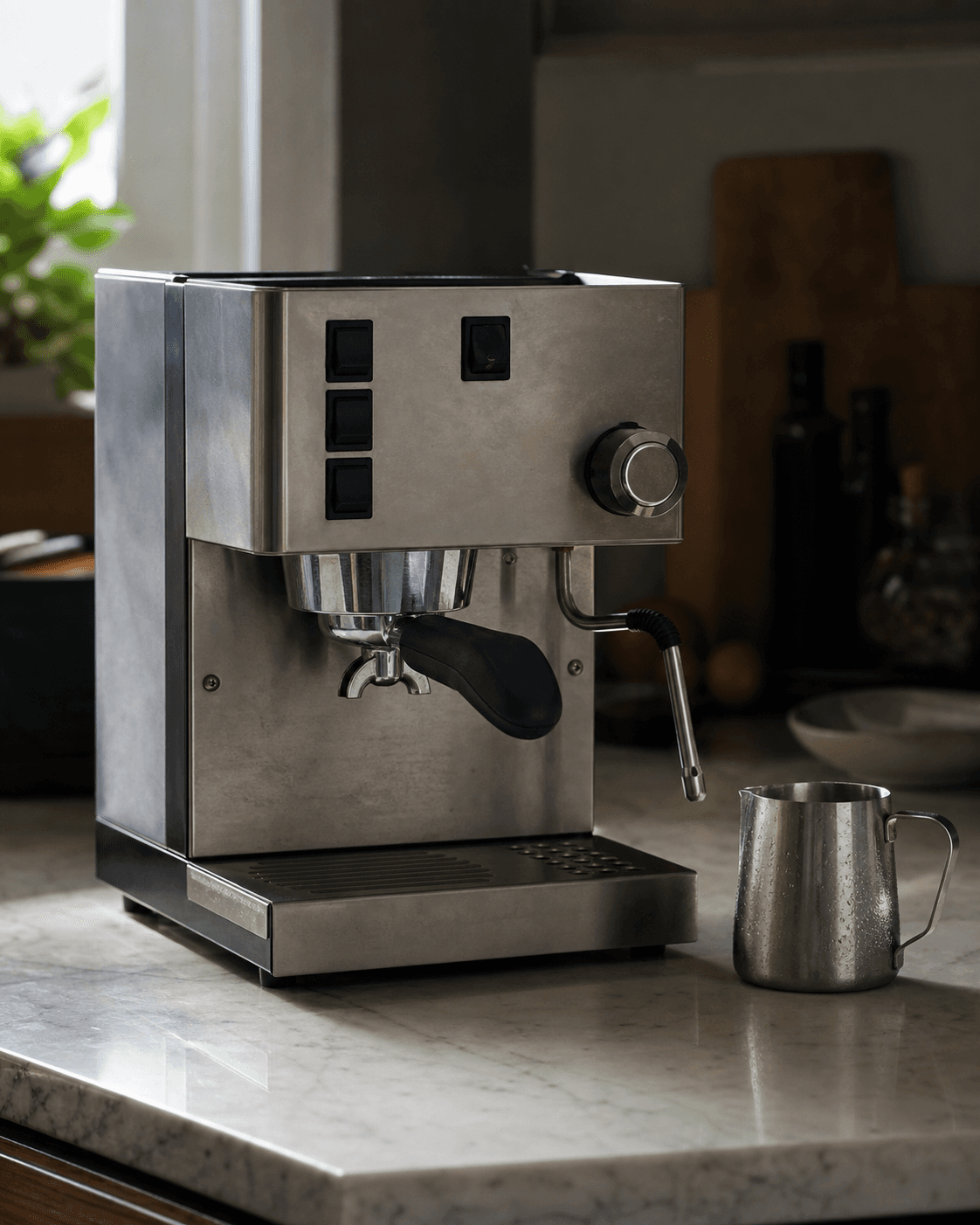
Pick one up and the pitch makes itself — it's heavy the way good tools are heavy. The chassis is powder-coated steel, the boiler is brass, and the group head is the same chunk of chromed metal Rancilio bolts onto its commercial gear. Nothing flexes when you lock in the portafilter. Nothing about it feels engineered to fail two months after the warranty lapses.
The deeper story is repairability, and it's the most underrated reason to buy this machine. Gaskets, the thermostats, the solenoid valve, the steam wand assembly — every wear part is cheap, standard, and a screwdriver away. There is a vast community and a healthy parts market built up over 25 years, which means a problem that would total a sealed super-automatic is, on a Silvia, a $12 part and a YouTube video. A ten-year-old Silvia isn't a museum piece; it's a Tuesday. Very few appliances at any price can say that.
The commercial 58 mm portafilter deserves its own mention. Cheaper machines use 51 or 54 mm baskets, which quietly locks you out of the enormous ecosystem of 58 mm accessories — bottomless portafilters, precision baskets, distribution tools — and means the technique you read about doesn't quite apply. On the Silvia it applies exactly, because you're holding the same size hardware a café barista holds.
Pulling shots: brilliant, once you earn it
This is the heart of the review, so let's take it in pieces.
Temperature stability — the honest weak spot
Out of the box, the Silvia's Achilles' heel is temperature. The single brass boiler heats up, the thermostat clicks off, the temperature drifts down a few degrees, then it clicks back on — and espresso extraction cares about those few degrees more than almost anything else. The traditional workaround is "temperature surfing": you learn the rhythm of the heating light and time your shot to land in the boiler's sweet spot. It genuinely works, and learning it teaches you a lot about how the machine behaves.
It's also a slightly absurd thing to be doing in 2026, which is exactly why an entire cottage industry of PID kits exists. Fit one and the story flips completely: the Silvia holds a set temperature to within a degree, shot after shot, and it stops being temperamental and starts being precise. I'd go as far as to say the machine is only two-thirds itself without a PID. Budget for the kit as part of the purchase, not as an optional extra.
Pressure and pre-infusion
The vibratory pump delivers the usual 15 bar, which the machine's design tames to roughly 9 bar at the coffee puck — where you want it. There's no programmable pre-infusion, but the Silvia gives you something better for learning: manual control. Feather the brew switch on and off at the start of a shot and you can improvise a pre-infusion by hand, easing water into the puck to reduce channeling. It's crude compared to a pressure-profiling machine costing four times as much, but it puts the variable in your hands, and that's the theme of the whole machine.
What actually transfers
Here's the payoff that justifies the price for the right buyer: everything you learn on a Silvia is real espresso skill, not "how to operate a Silvia." Dose, distribution, the WDT technique, tamping level and pressure, judging a shot by how it pours and tastes — all of it maps directly onto any proper machine you might upgrade to later. Learn on an automatic and you learn its buttons. Learn on a Silvia and you learn espresso. That transfer is the single best reason a serious beginner might start here.
Steaming: the quiet flex
For a single boiler at this price, the steam wand hits milk with real authority. You'll wait for the machine to switch from brew to steam temperature — a genuine limitation of the single-boiler design, since you can't pull a shot and steam simultaneously — but once it's up to temperature, the wand produces the kind of tight microfoam that lets you actually pour latte art rather than just dumping bubbly milk on top. Home machines twice this price often steam worse. If milk drinks are central to your routine, this is a real strength.
Living with it: the daily ritual
Daily use is a ritual, not a routine, and whether that's charming or exhausting depends entirely on you. A typical morning: switch it on and give it a real 20–30 minutes to reach stable thermal mass (rushing this is the most common reason new owners get inconsistent shots), flush the group, dose and distribute, tamp, pull, then wait for steam temperature and froth your milk.
There are genuine ergonomic annoyances worth knowing. The drip tray is small and fills faster than you'd like. The 67 oz water tank, while a healthy size, sits behind the machine, so you'll slide the whole unit forward to refill it unless you have clearance above. None of this is a dealbreaker, but all of it reinforces the machine's character: Silvia was designed around the coffee, not around your convenience.
Maintenance and longevity
Upkeep is simple and non-negotiable. Backflush with a blind basket and detergent regularly, descale on a schedule appropriate to your water hardness, and replace the group gasket every year or two when shots start to feel like they're leaking around the portafilter. Do that and the machine essentially doesn't die. This is the flip side of the repairability point: not only can you fix it, but the maintenance that keeps it alive is basic and cheap. Factored over a decade of ownership, the Silvia is one of the lowest cost-per-year machines you can buy, which reframes that $875 sticker considerably.
What to pair it with
The Silvia is only as good as what feeds it, and the grinder matters more than anything you'll bolt onto the machine itself. Pair it with a quality burr grinder capable of fine, consistent espresso grinds — this is not the place to save money with a blade grinder or a cheap doser. Beyond that, a few 58 mm accessories punch above their cost: a bottomless portafilter (which teaches you to spot channeling instantly), a distribution/WDT tool, and a decent tamper that fits the basket properly. And, once more for emphasis, the PID kit.
How it compares
Against the Breville Bambino Plus, it's a clean philosophy clash. The Bambino is faster to heat, PID-controlled from the factory, forgiving, and genuinely great on day one — but you will hit its ceiling, and its plastic-heavy build isn't built for the long haul. Silvia is slower to master and far better to keep.
Against the Gaggia Classic Pro, its most direct rival, the two are closer than partisans on either side admit. Both are single-boiler tanks with commercial 58 mm portafilters and cult followings. The Gaggia is cheaper and lighter and is the better pure value; the Silvia steams noticeably harder and simply feels a class above in the hand. If budget is tight, the Gaggia is the smart buy. If you want the nicer object and better steam, the Silvia earns its premium.
Against a super-automatic like the De'Longhi Magnifica, there's barely a comparison to make because they answer different questions. The super-auto is about convenience and consistency with zero skill; the Silvia is about control and craft. Buy the Silvia only if the second sentence describes what you want.
Known issues and honest gripes
No machine is perfect, and the Silvia's flaws are well-documented after decades of scrutiny. Temperature instability without a PID is the big one, already covered. The single boiler means brew-then-steam waiting. The small tray and rear tank are daily friction. And there's an experience cost that spec sheets don't capture: your first weeks with this machine may produce genuinely bad espresso while you learn, and there's no automation to paper over your mistakes. For the right owner that's a feature. For the wrong one it's a source of resentment. Know which you are.
Verdict
The Rancilio Silvia scores exactly where you'd expect a machine with this philosophy to score. Build and steam are near-flawless, and espresso quality is excellent once the machine is dialed and — ideally — PID-equipped. It loses points precisely where its character demands: it is not easy, and it is not cheap for what is, on paper, a single-boiler machine.
But "not easy" is the entire proposition, not a defect. If you want a machine that will still be pulling great shots long after cheaper rivals have been recycled, that will teach you real skill instead of hiding your mistakes, and that you can keep running with a screwdriver and $20 in parts, the Silvia remains one of the most rational purchases in home espresso. Just buy the PID kit with it. Your future self, and your future coffee, will thank you.
What we like
- Commercial 58 mm portafilter and a real brass boiler
- Built to be repaired, not replaced — parts are everywhere
- Steam power that punches well above its price
- Skills you learn on it transfer to any real espresso machine
What we don't
- No PID out of the box; temperature surfing is on you
- Needs a separate grinder to make any sense
- Zero hand-holding — the learning curve is the point
- Small drip tray and rear-mounted tank make daily use fiddly
Specifications
| Type | Semi-automatic |
|---|---|
| Boiler type | Single boiler |
| PID control | No (aftermarket kits available) |
| Pressure | 15 bar pump (9 bar at the puck) |
| Pre-infusion | Manual |
| Built-in grinder | No |
| Portafilter | 58 mm commercial |
| Water tank | 67 oz |
| Dimensions | 9.2 x 11.4 x 13.4 in |
| Warranty | 2 yr |
Frequently asked questions
Does the Rancilio Silvia have a PID?
Not from the factory. The stock thermostat swings a few degrees, so owners either "temperature surf" by timing the boiler cycle or fit an aftermarket PID kit for steady temperature. A PID transforms the machine and is the single most recommended upgrade.
Do I need a separate grinder?
Yes, and don't skimp. There's no built-in grinder, and the Silvia will happily expose a bad one. Budget for a quality burr grinder alongside it — arguably it matters more than the machine.
Is the Silvia too much machine for a beginner?
It can be. It rewards patience, not impulse. A determined beginner will learn faster on it than on an automatic — but if you want espresso with zero fuss, a Breville Bambino Plus will make you happier on day one.
How long does a Rancilio Silvia last?
Effectively indefinitely with basic maintenance. Every wear part is cheap and replaceable, and machines from the early 2000s are still in daily service. This is a buy-once appliance.
Keep reading
- Flair Neo Flex Review: Lever Espresso Without the Boiler, the Price Tag, or the Steam Wand
Fair
Our score: 69 / 100
- Lelit Anna PL41TEM Review: PID Included, No Asterisk
Good
Our score: 71 / 100
- Breville Dual Boiler Review: The Machine You Graduate Into
Excellent
Our score: 80 / 100
- Gaggia Classic Evo Pro Review: The Refresh Nobody Asked For, Except Everyone Did
Good
Our score: 72 / 100