Best Chef's Knives (2026)
None of the five knives in this guide is the single best chef's knife — that question doesn't have one answer, because a knife is a tool you hold for an hour a day, and hands, budgets, and cutting styles differ too much for one universal pick. What they have in common is that each earns its spot for a specific, real reason: one is the cheapest genuinely good option that exists, one is the traditional heavyweight everyone pictures, one is the lighter Japanese-influenced step up, and so on.
This guide picks from knives we've reviewed in depth, each with its own full write-up and score breakdown, and tells you plainly which type of cook each one actually fits — including where it doesn't.
If you only remember one thing: buy based on how you actually cook, not on what looks best in a knife block. A heavy bolstered knife rewards a rocking chop; a light thin one rewards precise slicing. Neither is objectively better.
Our top picks
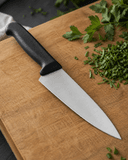 Best Overall ValueVictorinox Fibrox 8-Inch Chef's Knife
Good
Our score: 78 / 100
- Best Traditional German KnifeWüsthof Classic 8-Inch
Good
Our score: 78 / 100
- Best Step-Up Japanese-Style KnifeMac MTH-80
Excellent
Our score: 83 / 100
- Best Lightweight PickGlobal G-2
Good
Our score: 75 / 100
- Best Budget Premium FeelDalstrong Gladiator Series 8-Inch
Good
Our score: 70 / 100
Victorinox Fibrox 8-Inch Chef's Knife
Good
Our score: 78 / 100
Stamped blade, soft forgiving steel, and a grippy Fibrox handle for around $45 — the knife nearly every serious review, including ours, lands on as the default recommendation for most home cooks.
Wüsthof Classic 8-Inch
Good
Our score: 78 / 100
Forged, full-tang, full-bolstered, and built to be sharpened and used for decades. The heaviest and most substantial knife on this list, and the safest pick if you want one knife that does everything reasonably well.
Mac MTH-80
Excellent
Our score: 83 / 100
Thinner, harder steel, and a hollow-ground dimpled blade that measurably reduces food sticking. The right upgrade once you already own a chef's knife and want a real, noticeable performance gain.
Global G-2
Good
Our score: 75 / 100
A one-piece hollow stainless handle makes this the lightest knife in the lineup, with no seam for grime to collect in. Distinctive-looking and genuinely comfortable for long, repetitive cutting sessions.
Dalstrong Gladiator Series 8-Inch
Good
Our score: 70 / 100
A full-tang, full-bolster German-style knife with a sharp factory edge and an included sheath, at roughly half what Wüsthof or Zwilling charge for the same basic formula.
How we chose
Every pick here already has its own full review on this site with a complete score breakdown across performance, edge retention, build quality, ergonomics, and value — this guide doesn't rank knives we haven't separately evaluated. We prioritized real differentiation over padding the list: Japanese versus German blade philosophy, weight class, handle construction, and price tier all had to actually differ between picks, rather than including three near-identical German knives just to fill slots.
We also weighted honesty about tradeoffs over universal praise. Every knife here has a real limitation named in its own review — a heavier knife causes more fatigue, a harder steel is more brittle, a metal handle runs cold — and this guide reflects those same tradeoffs rather than smoothing them over for a cleaner-sounding recommendation.
What to look for
Steel hardness (HRC) is a tradeoff, not a spec to maximize. Harder steel (58-63 HRC) holds an edge longer between sharpenings but is more brittle and harder to correct once it does dull — it rewards someone who already sharpens with some care. Softer steel (54-57 HRC) dulls faster but comes back to a working edge quickly with basic tools, which is more forgiving for someone who won't invest in a serious sharpening setup.
Full bolster versus no bolster changes both balance and how you sharpen. A full bolster (Wüsthof, Zwilling, Dalstrong) shifts weight forward, suits a rocking chop, and protects your leading fingers — but makes sharpening the heel of the blade awkward without a guided system. A no-bolster design (Victorinox, Mac, Global) balances further back, sharpens edge-to-edge more easily, and tends to be lighter overall.
Weight determines what kind of fatigue you'll feel, not whether you'll feel any. A heavy knife (Wüsthof, Zwilling, Dalstrong, all 210-240 grams) tires your wrist on long, repetitive tasks but carries momentum through dense vegetables with less effort. A light knife (Global, Mac, both under 175 grams) is easier to control for fine precision work but needs more deliberate force for a heavy chop.
Handle material affects grip security more than looks. Textured rubber-like handles (Victorinox's Fibrox) and dimpled metal (Global) grip reliably wet or dry. Smooth wood or polished synthetic handles can get slick with wet or greasy hands regardless of how good they look on a counter.
Price above roughly $150 buys refinement, not a different category of performance. The jump from a $45 Victorinox to any $100+ knife is a real, noticeable upgrade. The jump from $150 to $300 within premium knives buys incremental gains — a slightly harder steel, a nicer handle material — for a much steeper price. Most home cooks get more value stopping in the $100-170 range than chasing the top of the market.
Frequently asked questions
What's the single best chef's knife for a beginner?
The Victorinox Fibrox 8-Inch — its soft, forgiving steel sharpens back to a working edge in under a minute with basic tools, which matters more for a beginner still learning technique than any premium steel's longer edge retention.
Is a Japanese-style knife better than a German one?
Neither is universally better — they suit different cutting styles. Japanese-influenced knives like the Mac MTH-80 and Global G-2 are thinner and lighter, favoring precise slicing and reduced fatigue. German knives like the Wüsthof Classic are heavier and bolstered, favoring a rocking chop and rougher use.
How much should I actually spend on a chef's knife?
Somewhere in the $45-170 range covers the real performance curve for a home cook — a $45 Victorinox is a genuinely capable daily driver, and $150-170 buys a real step up in steel or design. Above that, you're mostly paying for refinement and materials, not a fundamentally different cutting experience.
Do I need more than one chef's knife?
Most home cooks don't. A single well-chosen 8-inch chef's knife handles the overwhelming majority of kitchen tasks — a second knife is worth adding only once you've identified a specific gap, like wanting a lighter knife for fine work alongside a heavier one for rough chopping.
Does a more expensive knife need less maintenance?
Often the opposite for the hardest premium steels — they hold an edge longer between sharpenings, but when they do dull, they're harder to correct and more prone to chipping if mistreated. A mid-range knife like the Wüsthof or Dalstrong needs more frequent but easier maintenance.