Best Stand Mixers (2026)
Every stand mixer comparison eventually turns into a referendum on one brand, and that's not an accident — KitchenAid built the category's default shape decades ago and most competitors are still designing around it. That doesn't mean it's always the right buy. Bowl-lift versus tilt-head, motor wattage, included attachments, and price all pull in different directions depending on how often you bake and what you actually bake.
This list picks five mixers that earn their spot for genuinely different reasons — not five variations on the same machine. One's the safe default. One's for people who've outgrown the default. One's for a tight budget. One's for people who measure by weight instead of cups. Read the buyer profile in each blurb before you shop by price alone.
All five have full reviews on this site with complete score breakdowns — this guide is the short version of "which one, and why."
Our top picks
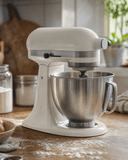 Best OverallKitchenAid Artisan Stand Mixer
Good
Our score: 74 / 100
- Best for Bread and Heavy BatchesKitchenAid Professional 600
Good
Our score: 76 / 100
- Best BudgetHamilton Beach Eye Candy Stand Mixer
Poor
Our score: 59 / 100
- Best for Precision BakingBreville Bakery Chef
Good
Our score: 75 / 100
- Best Value for a First MixerCuisinart SM-50
Fair
Our score: 68 / 100
KitchenAid Artisan Stand Mixer
Good
Our score: 74 / 100
Still the default for a reason — a 5-quart tilt-head with an all-metal gear train, ten speeds, and the largest attachment ecosystem in the category. It's not the most powerful mixer here, but it's the one that covers the most everyday baking needs without a specialist's trade-off.
KitchenAid Professional 600
Good
Our score: 76 / 100
The bowl-lift upgrade for anyone who's felt the Artisan strain on stiff dough or a doubled batch. A 6-quart bowl and a 575-watt motor handle loads the Artisan can't, at the cost of more counter space and about $100-150 more money.
Hamilton Beach Eye Candy Stand Mixer
Poor
Our score: 59 / 100
Under $130 and genuinely functional for cookies, cakes, and light batters, with a glass bowl that actually helps you judge whipped cream and meringue by eye. Don't ask it to mix bread dough regularly — that's not what the motor's built for.
Breville Bakery Chef
Good
Our score: 75 / 100
A built-in digital scale and a scraper beater that wipes the bowl wall automatically — the only mixer here solving specific baking friction points instead of just chasing bigger numbers. The pick for anyone who bakes by weight.
Cuisinart SM-50
Fair
Our score: 68 / 100
A fuller attachment bundle in the box, a slow-start ramp that kills the flour-cloud problem, and a three-year warranty, all for less than a KitchenAid Artisan. The easiest recommendation for someone buying their first stand mixer.
How we chose
Every pick here has a full review on this site with a complete, weighted score breakdown across performance, capacity/versatility, ease of use, build quality, value, and cleanup — nothing on this list is a guess based on a spec sheet alone. We weighted performance and capacity most heavily because that's where mixers actually separate from each other; everything on this list handles basic cookie dough competently, so the real test is what happens with a doubled batch, a stiff dough, or a thick buttercream.
We also deliberately avoided listing near-duplicates. Cuisinart makes two very similar mixers — the SM-50 and the Precision Master — and rather than list both and make you compare two nearly identical spec sheets, we picked the SM-50 for its slow-start feature and fuller attachment bundle. The Precision Master remains a solid alternative if it happens to be priced lower at the time you're shopping; check that review too before deciding.
Testing tier on every pick here is honestly disclosed as researched — evidence-based, drawing on manufacturer specs, owner-report patterns, and established category knowledge, not hands-on lab testing. We say so plainly rather than implying otherwise.
What to look for
Tilt-head vs bowl-lift. Tilt-head mixers swing the motor head back on a hinge to load the bowl — lighter, cheaper, and fine for anything short of heavy, stiff dough. Bowl-lift mixers raise the bowl up into a fixed head on a lever, which keeps a heavy or unevenly loaded bowl from rocking. If you bake bread weekly or double batches routinely, bowl-lift stability is worth the extra weight and cost. If you don't, it's dead weight you'll never notice using.
Motor wattage isn't the whole story. A 575-watt bowl-lift mixer and a 500-watt tilt-head aren't as far apart in real-world cake and cookie performance as the numbers suggest — wattage ratings are typically peak output, not sustained torque, and manufacturers don't measure them identically. The number matters most as a rough signal for stiff-dough performance, not as a precise, comparable spec across brands.
Bowl capacity you'll actually use. A 4-quart bowl handles a single batch of most recipes; 5 to 5.5 quarts gives real headroom for doubled batches; 6 quarts and up is genuinely useful only if you bake in volume regularly — for holidays, a crowd, or batch-and-freeze habits. Bigger isn't automatically better if it just means more mixer to store.
Attachments and the ecosystem question. KitchenAid's hub system — grinders, pasta rollers, spiralizers — is the deepest attachment ecosystem in the category by a wide margin, and it's the main non-obvious reason people pay a premium for the brand even when a competitor's core mixer performs comparably. If you'll never buy attachments, that ecosystem is worth nothing to you; if you might eventually want a pasta roller, it's worth planning around now.
Included accessories vary more than you'd expect. Some mixers ship with just a paddle, whisk, and dough hook; others add a splash guard, a recipe book, or in Breville's case, a built-in digital scale. Check the box contents against the price, not just the headline spec sheet — a $100 gap sometimes buys you accessories you'd otherwise purchase separately anyway.
Warranty length is a real signal, not boilerplate. KitchenAid's standard one-year warranty is short relative to its price; Cuisinart's three-year coverage on comparably priced mixers is a genuine point in its favor if longevity concerns you as much as brand reputation.
Frequently asked questions
What's the best stand mixer overall?
For most home bakers, the KitchenAid Artisan remains the best all-around pick — a 5-quart tilt-head with an all-metal build and the deepest attachment ecosystem in the category. It's not the most powerful option here, but it covers the widest range of everyday baking without a specialist trade-off.
Is a bowl-lift mixer worth the extra money over a tilt-head?
Only if you regularly hit a tilt-head's limits — stiff bread dough, doubled batches, or a wobbly bowl under a heavy load. For cookies, cakes, and light baking, a tilt-head does the same job for less money and less counter space.
What's the best cheap stand mixer?
The Hamilton Beach Eye Candy, at under $130, is the strongest budget pick here — a genuinely usable mixer for cookies and cakes, with a glass bowl that's a real usability feature. It's not built for regular bread dough.
Do I need a mixer with a built-in scale?
Only if you already bake by weight rather than volume — bread bakers and anyone following baker's-percentage recipes get real value from the Breville Bakery Chef's built-in scale. If you measure in cups, it's a nice-to-have, not a must.
How much should I actually spend on a stand mixer?
For occasional baking, $100-150 covers a genuinely capable machine. For regular baking including some bread, plan on $200-350. Bowl-lift capacity and specialty features like a built-in scale push the price toward $400-500, and that's only worth it if you'll use the specific feature regularly.