Researched
Death Wish Coffee Review: Is 'The World's Strongest Coffee' More Than a Gimmick?
The caffeine claim is legitimately backed by a real robusta blend, but you're trading nuance for punch — know what you're buying before you buy it.
On this page
The short version
I bought into the name skeptically — "world's strongest coffee" is exactly the kind of claim that usually turns out to be a font size trick. It isn't, entirely. Death Wish really does blend in robusta beans specifically to push caffeine content higher than a standard arabica coffee, and the roast is built to survive that. Whether the tradeoff in flavor is worth it depends entirely on what you're buying coffee for.
Buy it if caffeine content is genuinely your top priority and you don't mind a rougher, bolder cup to get there. Skip it if you're chasing flavor nuance — there are better dark roasts on this list for that goal, even if none of them will hit quite the same caffeine number.
Where it comes from, and the caffeine story
Death Wish Coffee started as a small Saratoga Springs, New York roaster and built its whole identity around the "strongest coffee" claim, backed by a blend of arabica beans and a portion of robusta — the hardier, higher-caffeine, lower-quality-reputation species that most specialty coffee avoids entirely. Robusta naturally contains roughly twice the caffeine of arabica, so blending it in is a legitimate, straightforward way to boost caffeine content rather than a marketing fiction. The company holds USDA Organic and Fair Trade certification, which is a genuinely different posture than most novelty-branded coffee products bother with.
The exact origin percentages aren't published in detail — you're told it's a blend, sourced partly from Latin America and partly from robusta-growing regions like India or Indonesia, without more granular farm-level transparency.
Roast profile: dark, built for extraction and punch
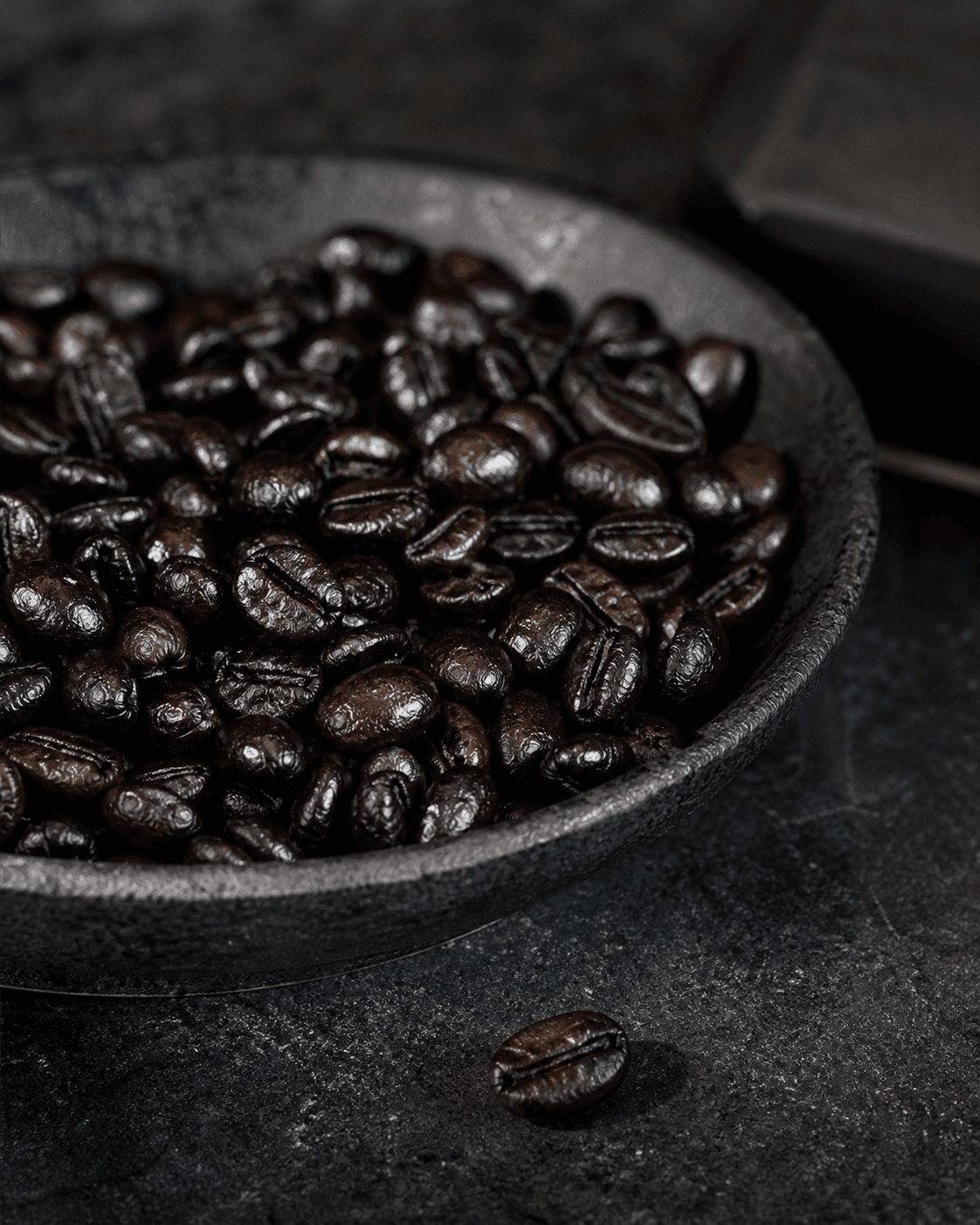
This is roasted dark — visibly oily beans, developed well past first crack. Dark roasting does two useful things for this product's goals: it masks some of robusta's harsher, more rubbery raw flavor, and heavier roast development statistically correlates with efficient caffeine extraction in the cup (though roast level affects extracted caffeine less than most people assume — bean composition and brew method matter more).
Aroma
Smoky and heavy dry, with a slightly harder, more industrial edge than Peet's Major Dickason's — less "chocolate and molasses," more straightforwardly roasted and bitter-leaning even before you brew it.
Acidity
Low, similar to other dark roasts on this list. Robusta itself tends to read as less acidic but more bitter than arabica, so the low-acid profile here comes with a bitterness tradeoff that Peet's all-arabica dark roast doesn't carry to the same degree.
Body
Heavy and thick, verging on syrupy — probably the fullest body in this entire batch of reviews, which is part of why it holds up so well diluted or iced.
Finish
Long and assertively bitter, with a lingering roasted, almost charred edge. This is not a subtle finish, and it's not trying to be.
Brewing it: built for volume and dilution, not precision
Drip coffee makers handle it fine, though at standard drip strength it can taste harsh — I'd recommend backing off the dose slightly from what you'd use with a milder bean. Cold brew is genuinely where this coffee makes the most sense: the long, cold steep softens some of robusta's rougher edges, and the bold body survives the eventual dilution with ice and water beautifully. It's a legitimately good cold-brew bean for that reason, not just a caffeine gimmick applied to a category it doesn't suit.
Espresso is possible but not where I'd point you — the robusta component's harsher bitterness gets concentrated and amplified under pressure extraction in a way that a well-blended all-arabica espresso bean like Lavazza Super Crema avoids. If you want a strong, punchy espresso shot, Lavazza or even Stumptown Hair Bender will get you there with less roughness.
Freshness and sourcing
Death Wish is roasted in the US and distributed through both grocery retail (it's sold at Walmart, among other places) and direct online sales. That dual-channel distribution means freshness varies more by where you bought it than with a purely direct-to-consumer brand like Lifeboost. The organic and Fair Trade certifications are real and independently audited, which lends some credibility behind the brand's louder marketing instincts.
Value per pound
At around $23 per pound, this lands in the same range as Stumptown Hair Bender, but you're buying a very different kind of value — raw caffeine punch and bold body rather than tasting complexity. If caffeine-per-dollar is your metric, this is probably the best value on the list. If flavor-per-dollar is your metric, Hair Bender or even Peet's will serve you better.
How it compares to Peet's and Lavazza
Against Peet's Major Dickason's, both are dark roasts, but Peet's is the more refined, more balanced cup — smoother, less bitter, no robusta harshness. If you want a dark roast that doesn't fight you, Peet's is the better everyday choice. Death Wish wins only if the caffeine number is genuinely the deciding factor for you.
Against Lavazza Super Crema, both blend in robusta for a reason — Lavazza for crema and body in espresso, Death Wish for raw caffeine and bold flavor in drip and cold brew. They're not really direct competitors; they're built for different jobs. Don't buy Death Wish expecting Lavazza's espresso performance, and don't buy Lavazza expecting Death Wish's caffeine kick.
Known gripes
The most common complaint, and one I share to a degree, is that the flavor doesn't quite justify the price once the novelty of the "strongest coffee" claim wears off — it's a solidly bold, caffeine-forward cup, but it's not winning on nuance against actual specialty dark roasts. Some buyers also report the bitterness is more aggressive than they expected from the marketing, which leans more on the caffeine story than on flavor description.
Verdict
The strongest-coffee claim isn't just hype — the robusta blend genuinely delivers more caffeine, and the bean is well-suited to cold brew specifically. But you're trading real flavor nuance for that punch, and if caffeine content isn't your main concern, Peet's or Stumptown will get you a better cup for similar or less money.
What we like
- Delivers a genuinely higher-caffeine cup thanks to the robusta blend component
- USDA Organic and Fair Trade certified despite the gimmicky branding
- Bold enough to survive milk, ice, or heavy dilution without disappearing
What we don't
- The robusta component brings a rougher, more bitter edge than an all-arabica dark roast
- World's strongest coffee marketing invites skepticism it doesn't fully earn on nuance
- Not a bean you'd reach for if delicate flavor or acidity balance is what you care about
Specifications
| Origin | Blend — Latin America and India/Indonesia (robusta component) |
|---|---|
| Process | Washed (blend, arabica/robusta) |
| Roast level | Dark |
| Tasting notes | Bold, smoky, cocoa, bittersweet with a harder edge |
| Roasted to order | No |
| Bag size (oz) | 12 |
| Price per lb (USD) | 23 |
Frequently asked questions
Does Death Wish Coffee actually have more caffeine?
Yes — the company blends in robusta beans, which naturally carry roughly double the caffeine of arabica, alongside a specific arabica selection and roast approach aimed at maximizing caffeine extraction. It isn't just a marketing name.
Does it taste bitter because of the robusta?
Robusta beans are inherently more bitter and less aromatically complex than arabica, and that comes through here — it's blended to be drinkable, but the edge is noticeable next to an all-arabica specialty coffee.
Is it good for cold brew?
Yes, it's a common cold-brew recommendation — the dark roast and bold robusta character hold up well over a long steep and don't disappear once you add ice and dilution.
Is this a good daily-drinker coffee?
If you like bold, caffeine-forward coffee and don't need subtlety, sure. If you're used to specialty medium or light roasts, the jump in bitterness and roast intensity will probably surprise you.
Keep reading
- Volcanica Ethiopian Yirgacheffe Review: Roasted-to-Order Freshness You Can Actually Taste
Good
Our score: 76 / 100
- Lavazza Super Crema Review: The Espresso Bean That's Basically Impossible to Beat on Price
Fair
Our score: 69 / 100
- Stumptown Hair Bender Review: The Blend That Made Third-Wave Coffee Mainstream
Good
Our score: 74 / 100
- Peet's Major Dickason's Blend Review: The Dark Roast That Started It All
Fair
Our score: 67 / 100