Best Food Processors (2026)
Most food processor shopping mistakes come down to buying the wrong size for how you actually cook, not buying the wrong brand. A 16-cup processor is wasted on someone who chops one onion at a time; an 8-cup processor is a daily frustration for someone who batch-cooks every Sunday. Motor power matters too, but less than the marketing on the box suggests — a lot of "1000 watt" processors are quoting a peak burst, not what the motor sustains under a real load.
We looked at six processors spanning $45 to $350 and picked the ones that actually differentiate themselves — on capacity, motor power, precision, or price — rather than five machines that all do the same thing at slightly different price points. Below are five picks, what each one is actually best at, and who should skip it.
Our top picks
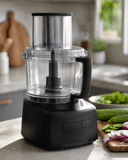 Best OverallCuisinart 14-Cup Food Processor
Good
Our score: 75 / 100
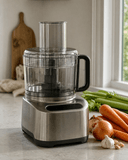 Best Splurge / Best for Precision SlicingBreville Sous Chef 16
Excellent
Our score: 82 / 100
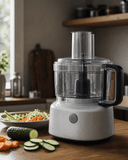 Best Value / Best Budget CapacityHamilton Beach 10-Cup Food Processor
Fair
Our score: 65 / 100
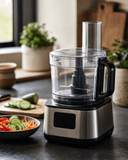 Best Build Quality / Best for Precise Slicing in a Compact SizeKitchenAid 9-Cup Food Processor
Good
Our score: 72 / 100
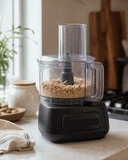 Best Powerful Budget PickNinja Professional Food Processor
Good
Our score: 70 / 100
Cuisinart 14-Cup Food Processor
Good
Our score: 75 / 100
The 720-watt motor and 14-cup bowl handle real batch cooking without bogging down, and the three-year warranty is the longest of any processor in this lineup. It's not the cheapest or the most precise, but it's the one most home cooks will be happiest owning five years in.
Breville Sous Chef 16
Excellent
Our score: 82 / 100
The 24-setting adjustable slicing disc has no real equivalent among cheaper processors, and the 1200-watt motor doesn't slow down on anything you throw at it. Worth the price only if you process vegetables often enough to use that precision regularly.
Hamilton Beach 10-Cup Food Processor
Fair
Our score: 65 / 100
A 10-cup bowl and an extra-wide feed chute for around $60 is a genuinely good deal, provided you accept a motor and lid fit that don't match pricier competitors. The best choice if capacity per dollar is your main concern.
KitchenAid 9-Cup Food Processor
Good
Our score: 72 / 100
A stainless bowl, a die-cast base, and an adjustable ExactSlice dial in a footprint that fits a smaller kitchen. The 300-watt motor is the weakest here, so it's a pick for precision and durability, not raw power.
Ninja Professional Food Processor
Good
Our score: 70 / 100
1000 peak watts for around $120 outmuscles processors that cost more, especially on dough and nut butter. The bowl and lid feel less premium than KitchenAid's or Cuisinart's, but the power-per-dollar is the best in this lineup.
How we chose
We compared motor power against real-world load handling rather than just the number on the box, since peak wattage claims vary widely in how they're measured across brands. Capacity was judged against realistic use cases — a 16-cup bowl is a genuine asset for batch cooking and genuine overkill for a single onion, so "biggest is best" isn't a useful framework here. Build quality was weighed by material (stainless versus plastic bowls, die-cast versus plastic bases) and by warranty length as a proxy for how confident each brand is in its own longevity. Ease of use and cleanup accounted for lid fit, control simplicity, and dishwasher-safe parts. Every pick below already has its own full review with a complete score breakdown; nothing here is ranked on marketing copy alone.
What to look for
Bowl capacity should match how you actually cook, not how you imagine you might cook. If you're processing one onion or a single batch of hummus, an 8-10 cup bowl is easier to fill evenly than a 14-16 cup one, where small quantities get thrown to the edges and chop unevenly. Batch cooks, big households, and anyone who freezes prepped ingredients should look at 12 cups and up.
Motor power matters most on dense jobs, not everyday ones. Chopping an onion or shredding cheese doesn't meaningfully separate a 300-watt processor from a 1200-watt one. Bread dough, nut butter, and hard root vegetables are where the gap shows up — if those are regular tasks, prioritize a stronger motor over other features.
Adjustable slicing discs are a real upgrade, not a gimmick, if you slice often. Fixed-thickness reversible discs are fine for occasional use; a dial-adjustable disc like Breville's or KitchenAid's ExactSlice saves real time if you're slicing potatoes, cucumbers, or cabbage regularly and want consistent thickness without swapping parts.
Build material predicts longevity better than price alone. Stainless bowls and die-cast bases (KitchenAid, Breville) tend to outlast all-plastic construction (Black+Decker, and to a lesser extent Hamilton Beach and Ninja). Warranty length is a decent proxy too — three years signals more confidence than one.
Cleanup is a bigger daily factor than most buyers expect. Dishwasher-safe parts are close to universal now, but bowl size and part count both affect how much of a chore cleanup actually is — a 16-cup bowl and five accessories take longer to wash than an 8-cup bowl and two.
Frequently asked questions
What's the best food processor for someone who's never owned one?
Start with something in the $50-130 range, like the Hamilton Beach 10-Cup or the Ninja Professional, rather than a premium model. It's cheaper to find out how often you'll actually use one before committing to a $300 machine.
Do I need a food processor if I already have a blender?
Usually yes, for different jobs — blenders excel at liquids and purees, while food processors handle chopping, slicing, shredding, and dough in ways a blender jar and blade geometry aren't built for.
Is a bigger bowl always better?
No — a bowl that's too big for your typical batch size means small quantities get chopped unevenly, tossed to the outer edge instead of caught by the blade. Match bowl size to your actual, typical batch, not your biggest imaginable one.
How much should I actually spend on a food processor?
For most home cooks, $150-220 (Cuisinart 14-cup territory) is the sweet spot — enough motor and capacity for real cooking without paying for precision features you won't use. Go higher only if you slice vegetables often enough to want an adjustable disc; go lower if your use is genuinely light and occasional.
Does motor wattage on the box tell the whole story?
No — many brands quote a peak wattage measured in short bursts, not sustained output. A lower-quoted-wattage processor with a well-engineered motor can outperform a higher-quoted one under real, continuous load, so treat the number as a rough guide, not a guarantee.